
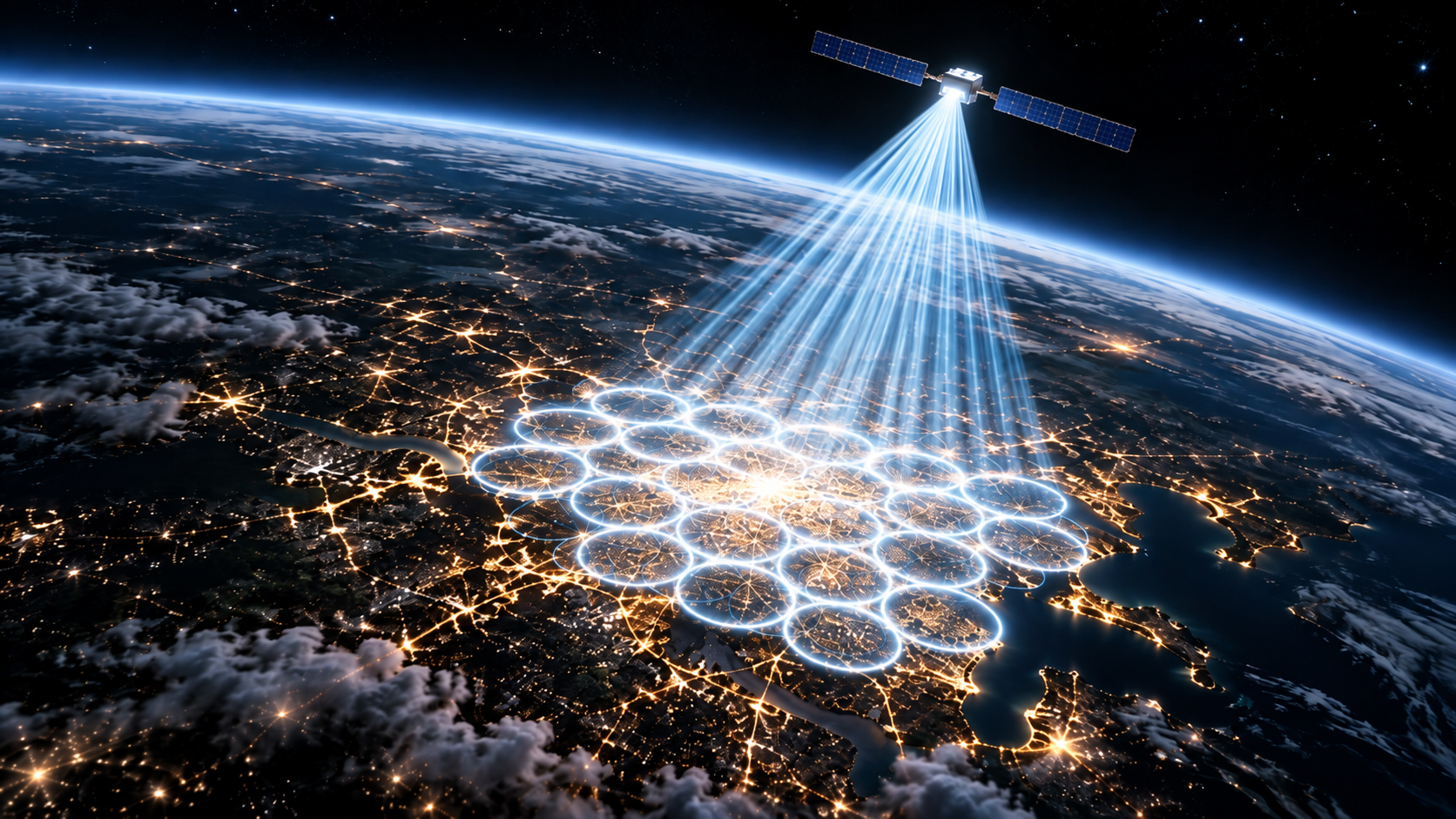
Starlink wants to become a mobile carrier. Could satellite connectivity do to wireless networks what streaming did to cable, or will physics keep terrestrial infrastructure firmly in the game?
By Pat Coyle
Four years ago, SpaceX and T-Mobile stood together in Texas and described a fairly easy-to-understand idea. Starlink satellites would fill the places where the terrestrial cellular network disappeared, allowing hikers, motorists and people living in remote areas to keep using the phones already in their pockets after they moved beyond the reach of a conventional cell tower.
At the time, the proposition looked more complementary than threatening. SpaceX needed T-Mobile’s spectrum, and T-Mobile gained coverage in places where building towers made little economic sense. Satellite appeared to extend the cellular network rather than replace it, and when the companies announced their partnership in 2022, they even invited other carriers around the world to participate.
Since then, the relationship between satellite and cellular service has become harder to describe so neatly. T-Mobile commercially launched T-Satellite in 2025, first for messaging and then for selected data applications. SpaceX began acquiring large amounts of its own wireless spectrum, announced plans for much more capable direct-to-phone satellites and started talking openly about terrestrial cellular infrastructure of its own.
This week, SpaceX moved further in that direction by agreeing to acquire as much as 14 MHz of paired nationwide 800 MHz spectrum from Grain Management. The spectrum is particularly useful for traveling long distances and penetrating buildings, and SpaceX described the acquisition as one of the remaining technical pieces needed for Starlink Mobile to become a major U.S. mobile carrier. Elon Musk went further, calling the spectrum the final critical piece of the puzzle needed for SpaceX to provide complete phone coverage across America.
Investors reacted as though the company had crossed an important line. Shares of Verizon, AT&T and T-Mobile fell roughly 6% in extended trading after the deal was announced. Forbes framed the news as another step toward direct competition with the established carriers, while Reuters reported that SpaceX is moving closer to mounting a direct challenge to them.
From coverage partner to competitor
For anyone old enough to remember what happened to the cable television business, the progression has a familiar look. Cable companies once controlled nearly the entire route between television programmers and consumers. They owned the connection into the home, assembled the bundle, operated the set-top box and sent the monthly bill. Then the internet created another route to the customer.
Netflix did not have to string a second wire into every house. It traveled over a broadband connection that somebody else had already built, gradually separating the television service from the company that owned the pipe. That model became known as over the top because the new service traveled over existing distribution infrastructure without being controlled by the company that owned it.
Cellular service presents a very different technical problem, and SpaceX is not following the same playbook. The comparison is still useful, however, because SpaceX began by riding on top of the existing mobile industry, using a partner’s spectrum to extend coverage from satellites, and has since started acquiring the assets needed to control more of the service itself.
Its spectrum purchases make that evolution visible. SpaceX agreed last year to acquire 50 MHz of S-band spectrum from EchoStar, along with mobile satellite spectrum rights, in a transaction initially valued at $17 billion. The broader set of SpaceX-EchoStar transactions subsequently grew to roughly $20 billion as more spectrum was added. SpaceX says the next generation of Direct to Cell satellites will use that spectrum, custom silicon, wider channels, phased-array antennas and 5G protocols to produce about 20 times the throughput per satellite and more than 100 times the overall capacity of its first-generation system.
By adding 800 MHz spectrum, SpaceX is also acquiring a layer with very different propagation characteristics. Lower-frequency spectrum generally travels farther and penetrates obstacles better than higher-frequency spectrum, although it provides less capacity for a given amount of bandwidth. Those qualities make it particularly useful for broad-area coverage and indoor service. SpaceX says it intends to combine that low-band layer with its 2 GHz spectrum and a terrestrial deployment.
Because that plan includes a terrestrial component, the story is already more complicated than satellites replacing towers. President Gwynne Shotwell said in August that SpaceX intends to build out the terrestrial side of the spectrum it acquired from EchoStar, while Musk has discussed using large numbers of relatively small base stations rather than relying entirely on the traditional macro-tower model. SpaceX now describes Starlink Mobile as a flexible architecture combining its satellite constellation with an advanced terrestrial deployment.
On a company earnings call, Shotwell went a step further by discussing the possibility of locating cellular base stations alongside Starlink broadband equipment and deploying smaller cells where additional capacity is needed. The concept remains preliminary, and SpaceX has not disclosed what such a network would cost, but it points to an important part of the company’s strategy: rather than simply reproduce the incumbent carriers’ tower network, SpaceX appears interested in seeing how much of its existing infrastructure can be made to serve another communications business.
Seen together, those plans begin to resemble a new kind of mobile network more than a satellite service. SpaceX would have satellites, licensed spectrum, terrestrial radios, backhaul, ordinary smartphones and potentially a direct relationship with the subscriber. The company that began by supplying coverage to a mobile carrier is now talking about becoming one.
Going over the top
AT&T, Verizon and T-Mobile have spent decades building terrestrial networks by buying spectrum, leasing tower space, installing radios, running fiber, maintaining sites and adding density as traffic grows. Large indoor properties create another layer of expense because outdoor cellular networks frequently cannot provide either the coverage or capacity required inside the building.
SpaceX arrives with a different asset base. Its launch capability serves far more than cellular service, while Starlink already sells broadband to homes and businesses and connectivity to aviation, maritime, government and other customers. Satellites, gateways, network operations, software and launch infrastructure can therefore support multiple revenue streams rather than a single mobile product.
Even with that advantage, the mobile buildout itself would still be enormously expensive. Recent spectrum acquisitions alone run into the tens of billions of dollars, and a competitive terrestrial network would require another substantial investment. SpaceX may nevertheless be able to spread parts of its infrastructure cost across businesses that a conventional mobile carrier does not have, while also attempting to reuse elements of a physical footprint that already exists for Starlink broadband.
Cable executives have seen a version of this advantage before. Netflix did not have to finance the broadband connection into every home before it could sell television over it because other businesses had already justified much of the infrastructure. SpaceX potentially benefits from a related economic structure. The rockets, satellites and Starlink network are not being created solely to sell cell-phone subscriptions, and SpaceX is now exploring whether some of the equipment supporting one service can help support another.
Whether those advantages remain decisive once SpaceX begins building a national terrestrial network is far less certain. Bernstein analysts recently estimated that a standalone SpaceX mobile network could require $50 billion to $130 billion of investment, including spectrum, and somewhere between 30,000 and 120,000 terrestrial sites depending on the architecture. Those are outside estimates rather than SpaceX plans, but they illustrate the scale of the undertaking. Shares of the large tower companies rose after the latest announcement because investors concluded that a serious Starlink Mobile buildout could create another major customer for terrestrial infrastructure.
AT&T CEO John Stankey has challenged SpaceX on essentially those grounds, arguing that once a rival tries to provide comparable terrestrial capacity in the places where mobile traffic is heaviest, many of the same costs begin to appear. SpaceX believes its architecture and existing infrastructure can change the economics. The incumbent view is that capacity eventually forces any serious mobile operator toward dense terrestrial networks.
Physics has other ideas
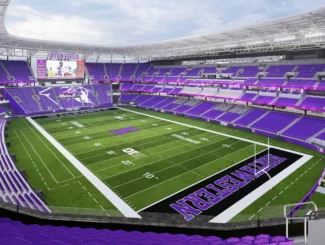
The limits become easier to see in a stadium, where the challenge is almost the opposite of the one satellite networks solve best. Satellites are extraordinarily attractive when geography is the problem. They can reach highways, mountains, farmland, oceans and remote communities where building enough terrestrial towers may never make financial sense.
Inside a stadium, geography collapses and density becomes the problem. Tens of thousands of users are packed into a comparatively small footprint, surrounded by steel, concrete, glass and one another. They also tend to reach for their phones at the same moments. A touchdown happens. The concert ends. Halftime begins. Tens of thousands of people suddenly want network capacity.
Serving that crowd requires more than getting a signal into the building. Modern stadium cellular systems divide the venue into many localized coverage areas, allowing capacity to be placed close to users throughout seating bowls, concourses, clubs, suites and back-of-house spaces.
AT&T made that distinction unusually explicit in September when it extended its partnership with the Dallas Cowboys. Its announcement noted that AT&T Stadium relies on more than 261 miles of fiber and nearly 1,000 antennas to support crowds that can exceed 100,000 people. The company summed up the engineering challenge in a single line: A satellite signal may reach a stadium, but it takes fiber throughout the venue to deliver the world-class experience fans increasingly expect.
For the stadium industry, that is the useful distinction between coverage and capacity. A satellite may be able to reach the venue, but that is not the same problem as serving tens of thousands of users inside it. AT&T Stadium’s infrastructure, which includes one of the country’s largest distributed antenna systems, illustrates how much terrestrial network density is still required once a crowd gathers in one place.
Early measurements of Starlink Direct to Cell point in the same direction, although they describe a much less capable system than the one SpaceX is now planning. A 2025 academic study of the first-generation network estimated mobile-data capacity at roughly 4 Mbps per satellite beam under outdoor conditions, with a possible path toward roughly 24 Mbps as spectrum and regulatory conditions improved. SpaceX says its next generation should increase overall Direct to Cell capacity by more than 100 times and provide an experience comparable with terrestrial LTE in many environments.
Even in describing those gains, SpaceX says its next-generation satellite service will augment high-capacity terrestrial 5G networks. Satellite may be able to erase a remarkable number of coverage gaps, but dense terrestrial infrastructure remains the more efficient tool when enormous demand is concentrated in a small area.
Verizon CEO Dan Schulman has been making essentially that argument. He says the advantage of terrestrial networks in cities and suburbs comes from densification and spectrum reuse because a terrestrial cell covers a much smaller area than a satellite beam. His conclusion is that satellite will complement terrestrial networks rather than displace them in the areas where most carrier revenue is generated. SpaceX is clearly betting that the competitive boundary falls somewhere else.
The stadium question
For venue owners and operators, the immediate question is narrower than whether Starlink can remake the national cellular market. It is whether satellite connectivity changes the need for dense indoor cellular infrastructure.
At least for now, the physics suggest it does not. A sold-out arena or stadium still requires localized capacity, sectorization and frequency reuse at a scale that favors antennas placed close to users. SpaceX has not announced a stadium DAS strategy, and there is no basis yet to assume that Starlink Mobile will participate in neutral-host venue networks.
If Starlink does become a fourth national carrier, however, the question will eventually become practical. It may need some way to deliver the service its customers expect inside major venues. That could mean participating in indoor networks much as existing carriers do. Satellite service might also provide an additional resiliency layer, while terrestrial radios carry the heavy traffic. Starlink could have a role in backhaul or temporary connectivity as well.
Those possibilities remain speculative, and they do not need to be resolved for the larger point to hold. Stadiums simply provide a clear example of why coverage and capacity are different engineering problems.
Meeting in the middle
The incumbent carriers are moving toward the same future from the opposite direction. AT&T, T-Mobile and Verizon announced a joint venture in May to pool resources and develop a common approach to direct-to-device satellite service, with the stated goal of supplementing terrestrial coverage where conventional networks do not reach. The three companies formally launched that venture this fall.
SpaceX is starting in space and moving toward the ground. The carriers are starting on the ground and reaching toward space. That convergence may ultimately prove more consequential than a simple contest between satellites and towers.
The television analogy bends at this point without entirely breaking. Streaming separated the television service from the company that owned the physical connection. Consumers discovered that they wanted programming, not necessarily a cable subscription, and the company controlling the coax no longer automatically controlled the customer.
Mobile users may eventually make a similar distinction. They want connectivity, and over time they may care less whether any particular packet travels through a Verizon tower, a Starlink satellite, a stadium DAS, high-density Wi-Fi or some combination of them. As devices and networks become better at moving among those paths, the underlying infrastructure could become less visible to the customer.
For venue owners, that way of thinking is already familiar. Their responsibility is not to provide one particular form of wireless service, but to make sure tens of thousands of people can connect reliably throughout the building. In most modern stadiums, that experience depends on both cellular and high-density Wi-Fi, each carrying different parts of the load.
Television offers another useful parallel. Streaming began as an exercise in unbundling, only to produce a new collection of bundles, platforms and aggregators. Consumers escaped one distribution model and eventually assembled another. Wireless may follow its own version of that cycle, with future phones moving among terrestrial cellular, satellite, Wi-Fi and private networks according to whichever connection offers the best combination of coverage, capacity, cost and performance at a given moment.
Under that scenario, Starlink Mobile’s most consequential effect would not necessarily be the replacement of the cellular network. It could be the gradual separation of mobile service from any single network.
For an industry built around owning spectrum and infrastructure, that would still represent a major change. SpaceX could become a formidable competitor even if it ultimately discovers that it needs many of the same towers, radios and indoor systems used by the companies it hopes to disrupt.