
A familiar pattern runs through the history of modern technology. A new approach proves its value with early adopters, spreads slowly, and then stalls. The broader market watches and waits, not because the technology doesn’t work, but because the pragmatic case for disrupting the status quo isn’t strong enough yet. Then a new business requirement emerges. The risk of not changing begins to outweigh the risk of change. And the market moves.
Geoffrey A. Moore studied this pattern closely enough to build a career around it. In his 1991 bestseller, “Crossing the Chasm,” he argued that the critical gap in technology adoption only closes when pragmatic buyers have a compelling business reason to act. While originally a guide for startups, the framework has evolved into a risk-assessment map for infrastructure owners because it describes the timeless psychology of market change rather than the specifics of any one era. This behavior has played out in cloud computing, smartphones, SaaS, and streaming, and it is playing out now in stadiums.
Converged stadium networks have followed this arc closely, because early adopters of new technology had a clear pragmatic reason to converge: efficiency. This was particularly important for new stadium builds. A single shared infrastructure reduced duplication, lowered construction costs, and simplified operations.
Dickies Arena as the first venue to adopt this model when it opened in 2019. When it opened in 2019, Dickes was the Innovator in Moore’s parlance, proving the technical viability of convergence by implementing what many believe was the first fully converged stadium network. In the years since, a small group of Early Adopters, including several high-profile new builds and a few pioneering retrofits, have followed suit, forming a solid “early market” that demonstrated the model’s efficiency.
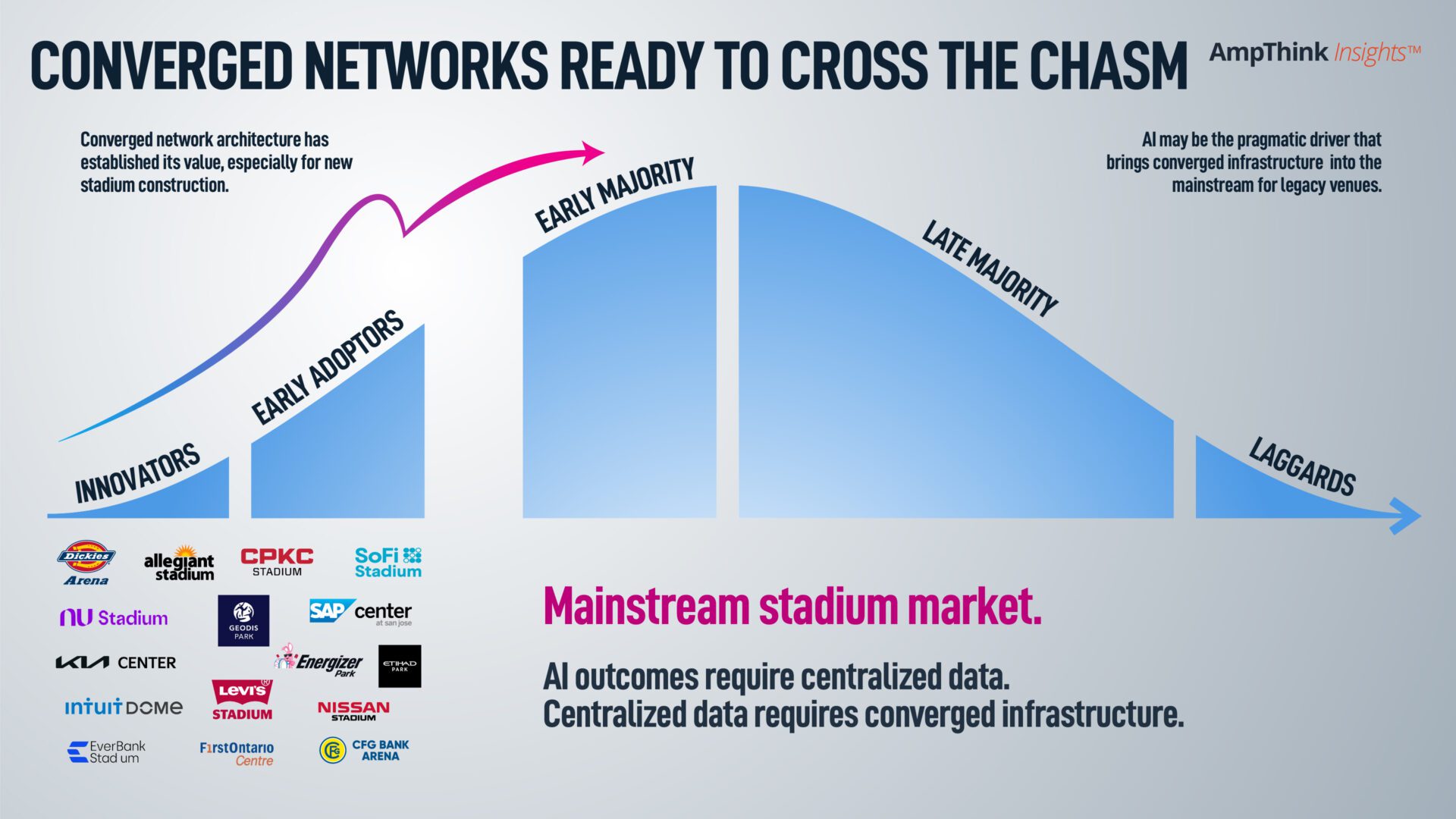


Despite these successes and the steady progress being made in new stadium builds, however, convergence has yet to cross the chasm into the Early Majority of existing venues. These Pragmatists, as Moore would call them, have remained on the sidelines, perhaps waiting for a compelling, pragmatic benefit that justifies the disruption of a major retrofit.
This is where AI enters the equation.
For the mainstream buyer, AI-driven gains in venue utilization and personalized revenue are no longer just “visionary” concepts; they are the business requirements that transform converged infrastructure from a technical experiment into a necessary foundation for economic survival
Since then, several new stadiums have followed Dickies lead, opting to build converged networks from the start. In addition, a small number of existing venues have chosen to converge their legacy networks to capture the documented benefits of the converged apporach. Yet despite strong evidence that the convergence model pays off in a retrofit environment, adoption among existing venues has been slow. There are logical reasons for this. Converting a legacy network to a converged network in an operating building is disruptive and requires significant investment. Without a pressing need it can be easy to defer. For owners of existing venues, the benefits of convergence have not outweighed the perceived risk. That is is what Moore describes as, “the edge of the chasm.”
According to Moore, what moves markets is not better technology but new business requirements. AI may be that requirement.
Stadium owners want what AI is promising: automated operations, higher venue utilization, and new revenue through personalization and sponsorship. But AI depends on one thing above all else: data. Not just more data, but connected data. Legacy stadiums built on parallel networks do not connect data. Each system collects data, but little of it is shared in real time. The building can see individual signals, but not the relationships between them. That limits what AI can do.
Converged infrastructure solves that problem. It creates an environment where data from across the venue can be accessed, analyzed, and acted on together. Now, in addition to being an efficiency strategy, convergence becomes the condition that allows AI to deliver meaningful economic outcomes.
This reframes the decision to implement convergence for existing venues. Not just “is convergence more efficient?” but also “can we fully realize AI without it?”
That question has real implications for owners making infrastructure decisions today.
The first is about timing. At what moment do AI-driven capabilities shift from experimentation to expectation? When do automation, utilization gains, and personalized upsells stop being differentiators and start being table stakes? Owners who wait for that moment to become obvious may find themselves behind it.
The second is about the trap of halfway measures. The (chasm) pattern consistently shows that hesitation carries its own risk. Investing in isolated AI tools that deliver incremental value, while other venues build integrated environments that compound over time, is not a neutral position. It is a choice with consequences.
The third is about priorities. Choosing the wrong AI application is a smaller risk than building infrastructure that cannot support where the market is going. Choosing what to do next is a more consequential decision than most owners may realize.