
The technology conversation in sports is dominated by two letters: AI.
Executives want to know what artificial intelligence, known as AI, will mean for security, fan engagement, staffing, operations, and the bottom line. Vendors are racing to position themselves as AI-enabled. Consultants are sketching roadmaps. Investors are circling.
But while the spotlight is on AI, there’s a quieter story unfolding underneath, one that may determine whether AI ever delivers on its promise inside stadiums at all.
It’s the story of another two-letters: IP.
Internet Protocol, known as IP, doesn’t make headlines, and it doesn’t demo well on a stage. But for the better part of 30 years, IP has been steadily spreading through stadiums one system at a time. Only now are we beginning to understand that this slow-motion shift may be the real inflection point in stadium infrastructure. IP is providing a critical foundation for whatever AI eventually becomes.
To understand why, it helps to rewind.


IP: The standard that turned information Into an economy
IP is the global standard that lets all digital information to flow. Digital signals are converted into packets of zeros and ones, transmitted over networks, and reassembled at the other end in the form of video, audio, text, financial transactions, and control signals. IP is the common transport language of the digital world.
Because the world uses IP as a standard mode of transporting digital information, the digital economy was able to scale. Today, roughly 15–20 percent of global GDP is tied to activities that depend on IP-based systems and networks.
Data-driven industries like finance, media, telecom, logistics, and software adopted IP early because their product was already information. Stadiums didn’t. Their core product was the live experience, so technology developed in isolated layers, each system with its own network, software, maintenance rhythm, and data format. That approach worked fine for a long time.
But IP kept creeping in anyway. And that has changed almost everything.
The middle story: How IP quietly took over stadiums
The spread of IP inside stadiums wasn’t the result of a grand plan from the start. It was incremental. It happened in waves.
The first wave came as the business of sports went digital. Ticketing, CRM, finance, email, websites, and all the back-office tools of a modern franchise moved onto IP-based systems. That shift lowered administrative costs, made monetary transactions easier to track, and allowed fan and sales data to be analyzed instead of just stored. Digital ticketing wasn’t just a convenience; it was one more step toward IP becoming the backbone of stadium business operations.
The second wave brought IP into the operational heart of the venue. Security cameras, IPTV, point-of-sale systems, access control, and eventually high-density Wi-Fi migrated to IP networks. This wasn’t philosophical. IP was cheaper to deploy, easier to scale, easier to secure, and easier for vendors to support. Owners saw lower lifecycle costs and more operational control. The building didn’t suddenly become “smart,” but it did become quietly digital. Systems still lived in silos. They just happened to be IP-based silos.
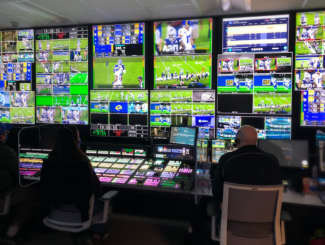
The third wave arrived when broadcast and media production shifted to IP. Routing, replay, mixing, encoding, remote production, and workflows that once depended on proprietary video transport increasingly ran over IP. That shift mirrored what happened across the rest of the internet economy: less specialized hardware, lower transport costs, greater flexibility, and more content created at lower marginal expense. And because broadcast demands engineered reliability, timing precision, and quality of service, those same networks began overlapping with, and sometimes depending on, the underlying venue infrastructure.
That’s the moment when convergence stopped being theory and started becoming design reality. And now we are entering a fourth phase.
More and more stadium systems are running on shared IP infrastructure, and increasingly communicating via APIs rather than hard-wired proprietary interfaces. Ticketing systems can talk to access control. Point of sale data can inform staffing and operations. Environmental systems can react to occupancy. Video, content distribution, and production workflows increasingly share the same backbone as everything else. Layers that used to be isolated are now at least aware of each other and, in some cases, beginning to coordinate.
At that point, the stadium stops behaving like a collection of independent machines.
It begins to look more like a programmable digital platform.
And that has real economic implications.
Shared IP infrastructure reduces duplicated networks, hardware, and cabling — lowering capital expense. A consolidated network environment simplifies support, monitoring, security, and lifecycle planning, lowering operating expense. Exposing data through APIs enables systems to interoperate without ripping out what came before. And once systems can finally share data, operators can optimize across them, matching energy load to demand, aligning staffing to real-world activity, smoothing throughput, anticipating maintenance issues, and tuning guest experiences.
None of this is speculative. It is happening now, sometimes intentionally, sometimes simply as a byproduct of modernization.
Which brings the story back to AI.
The quiet foundation beneath the AI conversation
AI is only as powerful as the data it can see.
And most of the data that matters in a venue – identity, transaction, movement, video, audio, building controls, content workflows – lives inside systems that historically have not shared data well.
IP doesn’t solve that problem alone. But it does standardize the way data moves, making it dramatically easier to collect, normalize, and analyze information across systems. As owners and operators experiment with AI, whether for operations, safety, service optimization, guest experience, or revenue strategy, they discover the same truth:
AI doesn’t work well in fragmented environments.
It works best when technology is unified, the data flows cleanly, and the network is engineered coherently. And the most proven way to achieve that, at scale, is through IP-based convergence.
So, while the industry debates what AI will become inside stadiums, the more important and more strategic question may be: Are venues building the infrastructure foundation required for AI to do anything meaningful at all?
The end of the story — or maybe the beginning
IP didn’t arrive in stadiums with buzz or fanfare. It arrived through line items, procurement cycles, system upgrades, vendor roadmaps, and operational necessity. It spread slowly, then steadily, and finally structurally.
Only now is the industry beginning to recognize what that shift means.
- IP moves stadiums toward convergence.
- Convergence makes data usable.
- Usable data makes software powerful.
- And powerful software has the power to make AI relevant.
That doesn’t make IP glamorous. But it does make it fundamental.
So, while AI earns the headlines, IP may remain the unsung hero of stadium infrastructure, the quiet standard that turns complex buildings into digital platforms.
And if history is any indication, the venues that understand that principle first will be the ones best positioned to capture the value of technology when the next wave, AI included, finally arrives at scale.