


How much is it costing yours?
Stadium owners spend enormous amounts of time tracking construction budgets, operating expenses and capital replacement plans. There is another technology cost they rarely measure: technical debt.
The term originated in software development, where it describes the future burden created when organizations make technology choices that solve an immediate problem but make systems more difficult or expensive to operate, maintain or change later.
In a stadium, that debt can take many forms: legacy infrastructure that must continue to be supported, proprietary integrations, redundant systems, manual workarounds, aging software, specialized labor requirements, poor documentation or architecture that makes every future change more difficult.
Unlike conventional debt, technical debt rarely appears on a balance sheet. The organization experiences it indirectly through higher operating costs, additional labor, slower projects, outages, expensive integrations and lost opportunities.
That makes it easy to underestimate.
Companies have started putting numbers on it
Technical debt may be difficult to see, but researchers have demonstrated that it can be economically significant.
McKinsey surveyed CIOs at large financial-services and technology companies and found estimates suggesting technical debt could equal 20 to 40 percent of the value of an organization’s technology estate before depreciation. Thirty percent of those CIOs said more than 20 percent of technology budgets intended for new products were instead being diverted to technical-debt issues.
McKinsey subsequently analyzed technical debt across 220 companies in seven sectors and five geographies. Companies with healthier technical-debt profiles also showed stronger business performance, although McKinsey cautioned that the relationship was correlation rather than proof of causation.
The individual examples are even more revealing. One multinational insurer discovered that technical debt represented between 15 and 60 percent of every dollar it was spending on IT. A large North American bank identified more than $2 billion in technical-debt costs across more than 1,000 systems and applications.
McKinsey has also estimated that existing technical debt can add roughly 10 to 20 percent to the cost of technology projects because organizations must work through accumulated complexity before creating anything new.
That begins to make technical debt look less like an abstract technology concept and more like an invisible tax on the organization.
What might that tax look like in a stadium?
There is an important limitation to the comparison. McKinsey studied corporations, not stadiums.
A bank or insurer may operate thousands of applications accumulated over decades. A stadium technology estate has a different composition, with more physical infrastructure, commercial systems and assets that are deliberately refreshed over time.
There is currently no reliable stadium-specific benchmark establishing that technical debt equals 20 percent, 30 percent or any other percentage of a venue’s technology estate. We should not pretend there is one.
Instead, the enterprise research gives us a starting point for asking a question stadium owners have largely ignored: If technical debt can become economically significant inside other complex technology environments, what might it cost over the life of a stadium?
Consider an illustrative $1 billion stadium. Assume technology represents 10 percent of construction cost, giving the building a $100 million opening technology estate.
Assume Year 1 technology operating expense equals 5 percent of that opening investment, or $5 million, and grows 5 percent annually. Assume the venue undertakes a major technology refresh every seven years equal to 30 percent of the original technology investment.
Under those assumptions, the stadium would spend approximately $332 million operating its technology over 30 years, plus another $120 million on four major refresh cycles, in addition to the original $100 million investment.
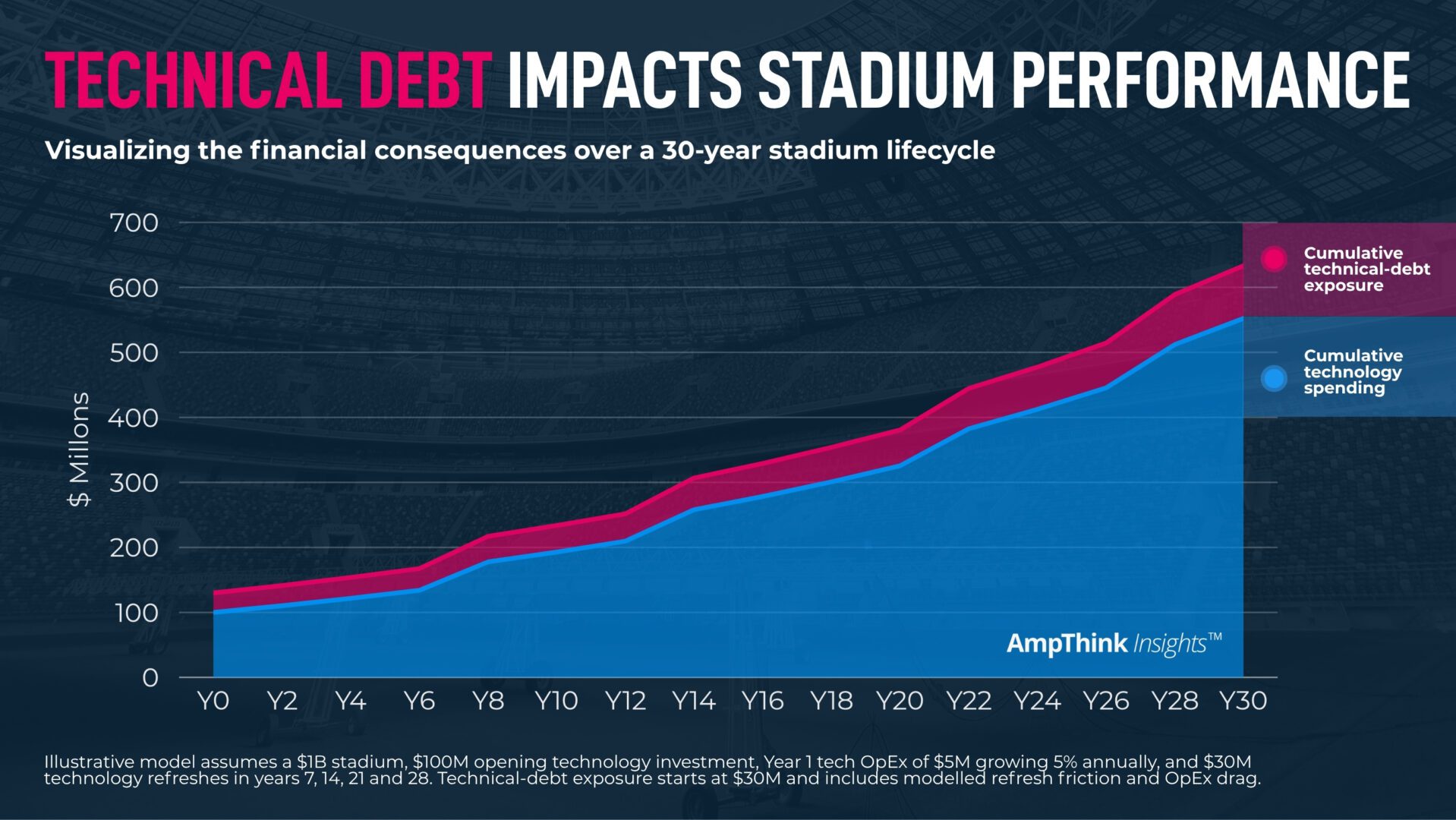


That produces more than $550 million in modeled technology spending over the stadium’s useful life. The question is how much additional economic burden technical debt could impose on top of that spending.
Using the midpoint of McKinsey’s enterprise technical-debt range as an illustrative proxy, combined with conservative assumptions for operating drag and additional refresh complexity, our model produces roughly $80 million of technical-debt exposure over 30 years.
That is not a stadium benchmark. It is a thought experiment intended to establish scale, not to suggest that every $1 billion stadium will incur $80 million of technical debt.
If the actual number is even a fraction of that amount, technical debt deserves more attention in stadium design, construction and lifecycle planning.
Some of the debt may be there on opening day
One of the most important implications of the model is when the burden begins.
Technical debt does not develop only as systems age. A meaningful portion can be embedded in a venue during design and construction.
Architecture choices, proprietary dependencies, fragmented systems, weak integration planning and operating models that require specialized workarounds can create future obligations before the first event is held.
Commercial decisions can play a role as well. Sports organizations routinely combine technology and sponsorship, and those partnerships can create significant value for both sides. But sponsorship teams may also negotiate technology rights or exclusivity while other departments are responsible for integrating and operating those systems.
If a sponsor-supported platform performs as intended and fits the broader architecture, there may be no problem. If it proves difficult to integrate, expensive to maintain, underperforms or constrains other systems, however, the owner may have accepted future technical debt in exchange for current sponsorship value.
That does not make the original decision irrational. Sponsorship revenue is real economic value, and accepting some technical debt can be a reasonable tradeoff.
The issue is whether the future technology obligation was visible when the decision was made.
Once those choices are embedded in the building, later systems may be designed around them. Staff processes adapt to them, refresh projects inherit them and new investments can become dependent on earlier compromises.
Technical debt can therefore be established during construction and compound from there.
That gives owners an important point of leverage. Starting with a lower technical-debt base should reduce the operating friction, remediation expense and refresh complexity that accumulate over the next 30 years.
The practical implication is that technical debt should be considered during design and construction, not only when an aging venue begins a modernization program.
Technical debt does not always look like failed technology
Technical debt is easy to associate with obsolete equipment or systems that no longer work. In practice, some of the more persistent debt may come from technology that continues to function.
A proprietary integration may work perfectly but make future systems expensive to connect. A redundant platform may remain reliable while requiring its own support staff, licenses and operating procedures. A manual workaround may keep an event running while quietly adding labor every time the building opens.
Value engineering can create another tradeoff. Reducing initial technology scope may help a project meet its construction budget, but the owner should understand whether the savings simply defer expense or create dependencies that increase operating and replacement costs later.
The same is true of sponsored technology. A favorable commercial agreement can lower initial CapEx or generate sponsorship revenue while simultaneously creating an architectural or operating constraint.
None of these decisions is automatically wrong. Technical debt becomes an ownership problem when the future obligation is neither recognized nor priced.
We can already see what it looks like
Technical debt does not always arrive as a failed multimillion-dollar system. Sometimes it arrives as a telephone.
STR previously examined the NFL requirement for analog ring-down phones on stadium sidelines. Modern NFL stadiums are overwhelmingly built around IP infrastructure, yet venues must still preserve dedicated analog pathways for this particular function.
Maintaining that capability can require dedicated conduit and cabling, analog telephone adapters, recurring continuity testing, specialized troubleshooting skills and documentation for physical pathways that become harder to trace after successive renovations.
The original infrastructure cost can be relatively modest. The important part is what happens afterward.
The building evolves around the requirement. Staff must continue supporting it, renovations must accommodate it, old documentation becomes less reliable and specialized knowledge must be retained.
Future projects inherit the constraint.
That is technical debt in miniature. The analog phone itself is not particularly expensive; the accumulated obligation surrounding it is the point.
Technical debt can survive a refresh
Replacing equipment does not necessarily eliminate technical debt.
McKinsey found that almost half of the organizations it examined that completed modernization programs were unsuccessful in reducing their technical debt.
That makes intuitive sense in a venue environment. A stadium can replace switches, access points, displays or servers while retaining the fragmented architecture, proprietary dependencies, manual operating procedures or organizational silos that created the debt in the first place.
A refresh can therefore carry old debt into a new generation of equipment. In some cases, new systems may become dependent on the compromises that preceded them.
This is one reason technical debt becomes harder to unwind over time. The organization does not simply accumulate old technology; it builds new technology around earlier decisions.
Not all technical debt is bad
Owners should measure technical debt, but that does not mean they should try to eliminate every instance of it.
Sometimes taking on debt is rational. A project may need to meet an opening date, a temporary integration may be necessary or sponsorship economics may justify accepting a technology constraint.
A venue might also select a less flexible solution because its near-term savings outweigh the expected future cost. Those can be legitimate ownership decisions.
The danger comes when the future cost is invisible.
Today, stadium owners can generally identify the acquisition price of a technology system. They can usually estimate its maintenance expense and forecast when major equipment will need replacement.
What they often cannot identify is how much additional cost today’s architecture will impose on tomorrow’s operations, integrations, staffing and capital projects.
That is the gap this model is intended to expose.
The $80 million number is not the conclusion
The model should not be interpreted as evidence that technical debt costs a stadium $80 million. The more consequential conclusion is that we do not currently know what it costs.
That uncertainty would matter less if the potential burden were small. Enterprise research suggests it may not be.
Stadiums are becoming increasingly dependent on interconnected technology while simultaneously being asked to operate more efficiently, support more events and generate greater economic value from the same physical asset.
If technical debt raises the cost of operating that technology, slows future change or prevents systems from producing their intended value, then it is ultimately an ownership issue.
The industry needs a stadium-specific way to identify technical debt, determine where it resides and quantify the operating and capital burden it creates. Enterprise research does not provide that benchmark, but it gives owners a reason to start looking for one.