
How early technology decisions shape operations and business performance at SoFi Stadium and Hollywood Park
When building a new stadium, the most important technology decisions are not always the ones fans notice first. Long before opening day, stadium owners make choices about the building’s infrastructure and whether it can adapt as the venue’s needs change. Those choices affect how efficiently the venue operates, how easily it evolves, and how much commercial value it can create over time.
For SoFi Stadium, the critical choice was to build a converged network. Today, after five years in the building, I see that choice less as a technical design preference and more as a decision about control. The value was not only that the strategy reduced capital cost and helped the stadium operate on opening day. It was that the owner had a foundation it could continue to operate, govern, and expand.
Choosing to build a converged network may sound logical in hindsight, but it was not the default way to build stadium infrastructure at the time. Stadium construction projects are normally organized by scopes, and each scope tends to solve for itself. Security may have its own network and servers. BMS may have its own fiber and system. Wi-Fi, broadcast, A/V, access control, parking, public safety, and other systems all have their own requirements.
When each system brings its own network, compute, cabling, and operating model, the owner can inherit a building full of separate technology islands. Each island may work on its own, but together they create duplication: cable that did not need to be run, compute that did not need to be purchased, and separate systems that have to be monitored, secured, patched, and upgraded over time.
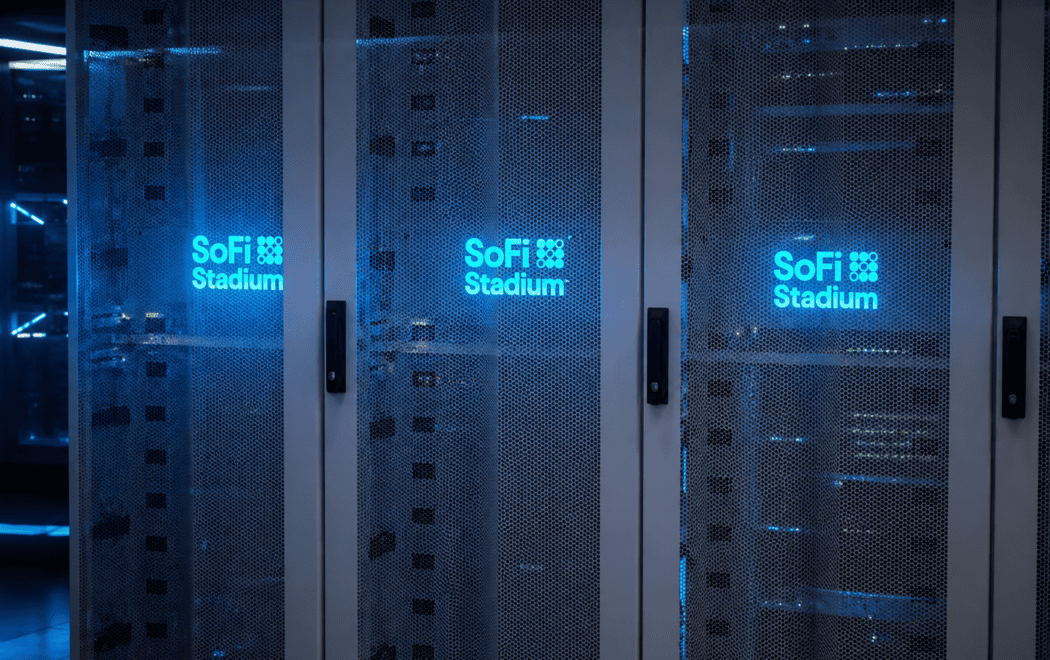
Hollywood Park took a different approach. It created one unified network and compute foundation that could serve the stadium and campus as shared owner infrastructure.
A campus requires flexibility
There is a tendency to say SoFi Stadium is different because of its size. In some ways, of course it is. But every venue that gets built or refurbished has to install, manage, secure, and operate the infrastructure that supports it. The scale may change. The ownership question does not. Still, the value of convergence became even clearer as the Hollywood Park campus took shape.
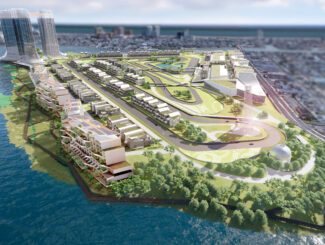
SoFi Stadium is the anchor of Hollywood Park, but the campus is much bigger than the stadium. It is part of a 298-acre mixed-use development that includes residential buildings, retail, YouTube Theater, parking, and other assets. Even the parking lots were planned with future development in mind. The network could not be designed only for the stadium as it existed on opening day. It had to support a campus that would keep changing.
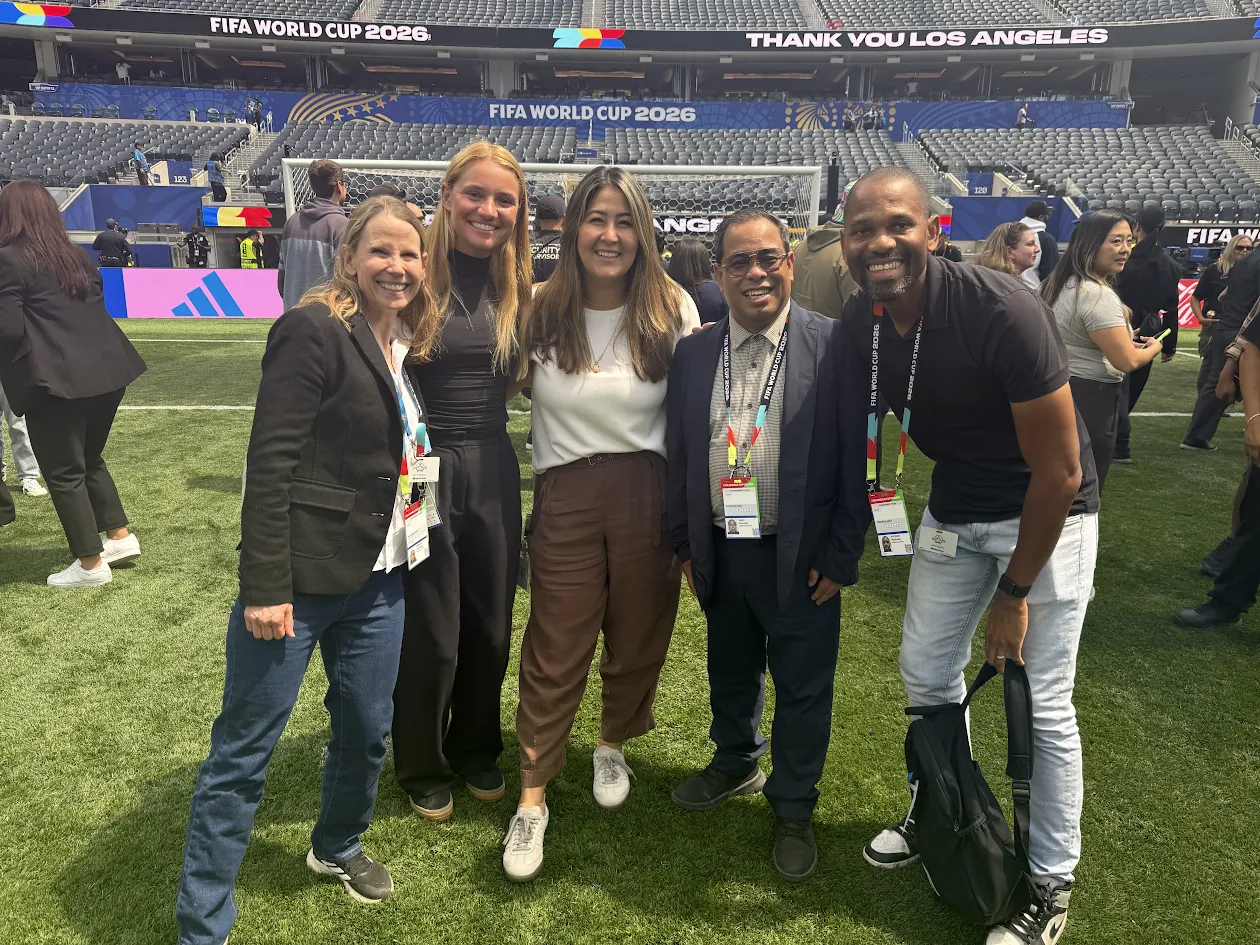
From left: Janette Smrcka, Emma Kaiser, Brenda Suh, Ron Dico, Michael Rucker
That changes the role of technology. At Hollywood Park, we are also a landlord, managing not just the venue but the campus around it. We do not want people to come only for the game. We want them to come for the entire experience. Tourism, trip planning, retail, parking, and long-term visitor engagement become part of the conversation. A campus like that needs technology that can support the whole ecosystem, not just the event.
The converged foundation gives us that flexibility. We can use stadium infrastructure to support other parts of Hollywood Park rather than installing separate systems everywhere. Campus buildings can be tethered to the stadium infrastructure, but if a building ever needed to stand on its own, that could be done without disrupting the rest of the campus. We did not need to buy all that infrastructure on day one, but we did need to preserve the ability to change the campus over time.
That is what good infrastructure does. It preserves options.
From connected systems to usable data
The value of a converged foundation is not limited to connectivity. Once more systems share common infrastructure, the owner is in a better position to understand what those systems are doing and use that information across the business. That is where the conversation about data and AI begins.
At SoFi, HVAC, media, security, telephony, building systems, signage, operations, and guest-facing systems all tie back to the network in some way. Each system creates information about how the building is operating, how people are moving through it, how assets are performing, or where attention may be needed. Even physical assets can become digital assets: you can put a camera on them, add a sensor, or collect data from systems that are already attached to them.
But more data is not the goal. The goal is better decisions. In most cases, collecting information from each system is not the hardest part. The harder work is deciding which data is worth collecting, whether it can be trusted, and which operating or business decision it is supposed to improve.
That is also where AI becomes relevant. AI is only useful if the underlying data is accessible, structured, and connected to a workflow where someone can act on it. Once the core systems are in place, the focus shifts from keeping systems connected to using information to operate more efficiently, protect the business, and create new value.
A practical example: temperature monitoring
One example is temperature monitoring. You do not need a converged network just to measure temperature, and we could have solved this problem by installing dedicated sensors in every IDF room. But we have well over 250 IDF rooms, so that would have meant more hardware, more installation, more maintenance, and another system to manage.
Instead, we used data that already existed inside the infrastructure we own. The switches report air intake temperature, so we used that as a proxy for room temperature. We set up dashboards and alerts to identify rooms that were overheating and get the engineering team in there before it was too late.
This is not a flashy use case. Guests will never walk into the stadium and notice it. But it shows why owner-controlled infrastructure matters. The value was not just collecting a data point. It was using data we already had to reduce risk, avoid unnecessary expense, and respond before a minor issue became an event-day problem.
Over time, that same signal can become part of a larger operating workflow. An overheating room might trigger an alert, create a work order, prompt the engineering team to check the HVAC serving that space, or eventually support a more automated response. Our converged infrastructure provides a better foundation for connecting systems, people, and processes around the same operational problem.
The same logic applies to the business more broadly. Once the foundation is unified, data does not have to remain trapped inside separate systems. The owner is in a better position to ask questions that cut across the venue: how staffing affects service, how energy use relates to event schedules, how sponsorship assets are performing, how guest behavior changes by event type, or how utilization changes across the campus.
That is the larger lesson from operating SoFi Stadium. The value of convergence is not only that systems connect. It is that the owner has more control over how the building operates, how the campus evolves, and how information can be used across the business.
Three decisions owners should make early
New construction gives owners the cleanest opportunity to create that foundation because the pathways are open, trade scopes are still being defined, and the operating model has not yet hardened around separate systems. Existing venues can move in the same direction over time, but the work is harder after opening day.
For teams building new venues and districts, that lesson points to three decisions that should be made early.
First, decide who controls the network and compute foundation. If every system brings its own infrastructure, the owner will live with that fragmentation long after construction is finished. A converged foundation gives the owner more control over cost, operations, security, upgrades, data, and future use cases. Convergence is an ownership strategy decision, not just a technical design preference.
Second, think about capacity. Put in more fiber than you think you need. You do not have to terminate it all on day one, but when the ground is open and the pathways are available, that is the time to create capacity for the future.
Third, document everything. In a converged environment, the same fiber may support infrastructure, ISP, public safety, DAS, security, media, signage, and future applications. You need a single plan. You should know what is in use, what capacity remains, where systems connect, and where they do not. That kind of documentation is much easier to create at the beginning than to reconstruct later. To me, that is core best practice.
Five years into operating SoFi Stadium, that is the lesson I keep coming back to. Convergence gave us more than a network. It gave us a foundation the building, the campus, and the business can keep building on.