
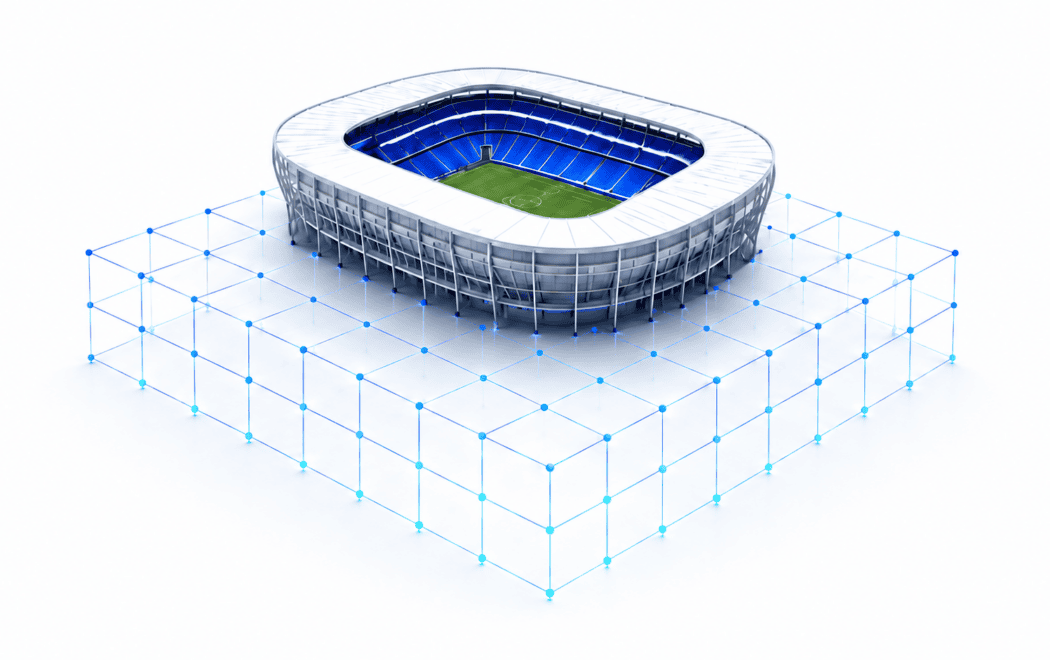
The network is one part of stadium technology nobody buys a ticket to see. Yet it may be the technology that determines whether everything else in the building was worth the price of admission.
That hidden value is hard to measure because the network usually disappears behind the systems it supports. While the Wi-Fi, audio, IPTV, broadcast, security, and HVAC systems each have an obvious job, the network that supports and connects them can look like a commodity, seen as a cost to be contained instead of an investment that grows in value. As a result, its true value is easy to overlook.
The idea of the network effect offers a way to think about that hidden value. The concept helps explain why a network can become more valuable as it gets bigger. A telephone became more useful when more people had telephones. A fax machine became more useful when more businesses could send and receive faxes. Even messaging networks, social platforms, and two-sided marketplaces increase in value as more users join. The only question is: by how much?
In the 1980s, Metcalfe’s Law offered an answer to that question. Developed from the logic of compatibly communicating devices, it argued that the value of the network itself could grow exponentially as more compatible nodes joined.
The common shorthand for Metcalf’s model was straightforward:
Network Value ≈ n²
This formula mattered not only because it was quantifiable, but because it shifted attention from individual devices to the network around them. The network effect often describes why the user or owner of a connected product gains value as the network expands. Metcalfe’s Law helped show why the network itself could gain value as more compatible nodes are added. The math was meant to justify owners making larger investments in network technologies.
There may be a stadium version of that idea. It does not come from more fans joining a social platform or more buyers and sellers joining a marketplace. It comes from more technology systems becoming usable through a common network foundation.
That is where convergence enters the stadium business.
For years, stadium technologies have been bought and built as separate systems. Wi-Fi could have its own network. So could IPTV. Audio, lighting, security, point of sale, building management, and other systems could arrive with their own switches, cabling, support paths, and operating assumptions. That model was understandable when many systems were less digital, less interconnected, and less dependent on real-time coordination. That model becomes harder to defend when the building itself becomes a technology-dependent operating environment.
A converged stadium network changes the economics in two ways. It is more efficient to build because it eliminates the need to pull multiple parallel networks. It is more effective because a common platform gives systems a better chance to become useful together.
Convergence does not happen automatically. Wesley Terry, network architect at AmpThink, draws an important distinction: “A converged network is not one big flat network. It is a common platform.” In other words, the work is not simply connecting everything together. The work is creating a structure where different technologies can share infrastructure and the resulting system is more efficient to manage.
Terry argues that a stadium network should not depend forever on the person who designed it. It needs a framework that can be understood, supported, repeated, and adapted as new technologies come into the building.
The goal is not to make every system talk to every other system immediately. The goal is to give the building the ability to make the right connections later, under the right rules. The logical side of the network, including IP addressing, VLANs, routing, and segmentation, helps define how technologies are separated and how they are allowed to communicate.
Vendor onboarding is where that framework becomes operational. A converged network does not work because every vendor gets a port and is told to plug in. It works when each system is given a proper place on the network. As Terry puts it, “A converged stadium network only creates value if the systems that depend on it can actually join it cleanly.”
That is the difference between a shared platform and a pile of exceptions.
Compatibility was a key element of Metcalf’s network value theory. Networks grow in value when more compatible devices connect. And his theory is born out for like nodes and like devices (e.g., phones). Now converged networks are bringing previously disparate systems that used to run on parallel networks onto common platforms. IP gives every system common data protocols. Software controls allow these different systems to interact in ways they couldn’t if they were on separate networks. In a sense, convergence creates a compatibility that wasn’t there before, which increases the number of compatible systems. One could argue, therefore, that convergence makes the network more valuable.
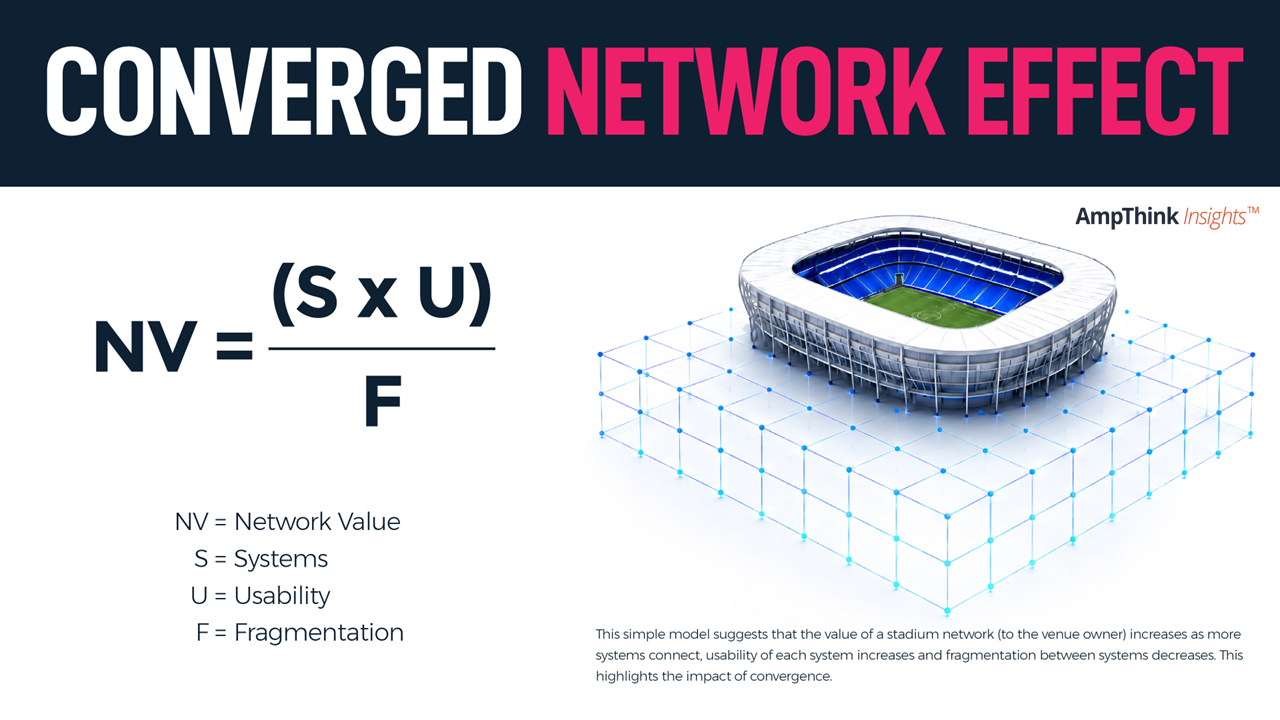
One way to express this idea is:
Network Value = Systems × Usability ÷ Fragmentation
Or:
NV = S × U ÷ F
This is not a financial formula. It is a model for thinking about the business logic of convergence.
Systems is the number and importance of venue and district systems that depend on the network. These can include Wi-Fi, A/V, media, security, building systems, commerce, parking, ticketing, tenant systems, event systems, and operating platforms. Convergence can tame the complexity normally associated with multi-system networks by giving those systems a common foundation.
Usability is the venue’s ability to use those systems in real operating conditions. Can staff, vendors, operators, and event partners access, monitor, support, change, hand off, and coordinate them without unnecessary engineering overhead? This is where converged networks continue creating value after opening day.
Fragmentation is the structural drag created when systems remain separated by infrastructure, vendors, tools, data paths, permissions, documentation, support models, and operating workflows. Convergence should reduce fragmentation. The model asks owners to consider how much value is created when that fragmentation is avoided.
That denominator matters.
A stadium can have good technology and still be hard to operate. It can have strong individual systems and still struggle to coordinate them. It can invest in better tools and still create more complexity if each system arrives with its own assumptions, support path, and operating model.
Fragmentation is the opposite of convergence. It creates friction through more hardware, more fiber, more vendor handoffs, more troubleshooting paths, more undocumented exceptions, and more people required to make the building work. Fragmentation therefore limits the value of a stadium network.


A converged network does not eliminate complexity. It can organize complexity so the venue has a better chance to operate it.
That is where value may show up. A usable network does more than work. It reduces the effort required to use the building. If a broadcast partner can connect to the venue network in an hour instead of a day, if a sponsor activation can be supported without custom infrastructure, if a less technical operator can run a system without an engineering team, or if a venue can change formats on a tighter schedule, the network is generating operating leverage.
That leverage creates value because stadium space is a perishable asset. Every unused hour in a club, concourse, plaza, parking area, or district space is lost inventory. A more usable, less fragmented network can help the venue support more events, more event types, more partners, and more commercial use cases with lower operating overhead.
This is why convergence matters now. Stadiums operated for decades without converged networks because the building was different. The systems were fewer, less digital, less dependent on one another, and less tied to a district operating model. Modern venues are different. They are data-dependent, media-intensive, security-conscious, event-variable, and increasingly district-oriented.
As systems multiply, the cost of fragmentation likely rises. That is why the value of convergence should rise as it reduces or eliminates silos.
Metcalfe developed his formula to help corporate technology buyers rethink investments in network technology. His simple equation helped them see that the value of a network was not limited to the cost of the connections. It could grow as more compatible nodes joined.
Stadium owners have a similar opportunity, and it also revolves around the value of compatibility. The lesson from convergence is that compatibility is not only a technical condition. It can be designed, governed, and operated.
Venue leaders should not focus only on what their networks cost to build. They should also ask what their networks will make possible across every system the building depends on.
When the value the network creates exceeds the cost of building it, the converged network effect begins to emerge.