
The Internet is no longer a human network. With connected devices projected to surge past 30 billion by 2030, we have officially entered an era where the silent conversations between machines far outpace the digital footprints of the people who created them.
– Hans Vestberg, Chairman and CEO, Verizon, CES 2019
When Vestberg made this claim in 2019, he was describing a structural shift in the way people communicate. For decades, online networks were designed primarily to connect people. The next phase, according to Vestberg, will be driven by machines talking to machines. That prediction is now bearing out across the commercial landscape and has important implications for stadium infrastructure.
Indeed, network growth inside buildings today is increasingly driven by connections between sensors, cameras, automation systems, robotics, and embedded intelligence. Global forecasts project roughly 39 billion Internet of Things (IoT) devices by 2030, growing about 13 percent annually, with AI accelerating demand for real time operational data. That equates to multiple connected devices per person worldwide and rapidly increasing device density inside physical spaces.
In office buildings, hotels, and airports, sensors for lighting, HVAC, security, occupancy, and operations are often deployed at densities approaching one device per 100 to 250 square feet, with higher concentrations emerging as automation expands. IoT is becoming part of the infrastructure of commercial buildings.
At those growth rates, total endpoints in many environments could reasonably double over the coming decade. Some categories may grow faster. Research tracking smart buildings and smart venue technology regularly projects mid-teens to low twenties CAGR, according to firms such as Grand View Research. An increase of two to three times over ten years is consistent with those trajectories.
Stadiums are now approaching the surge Vestberg described.
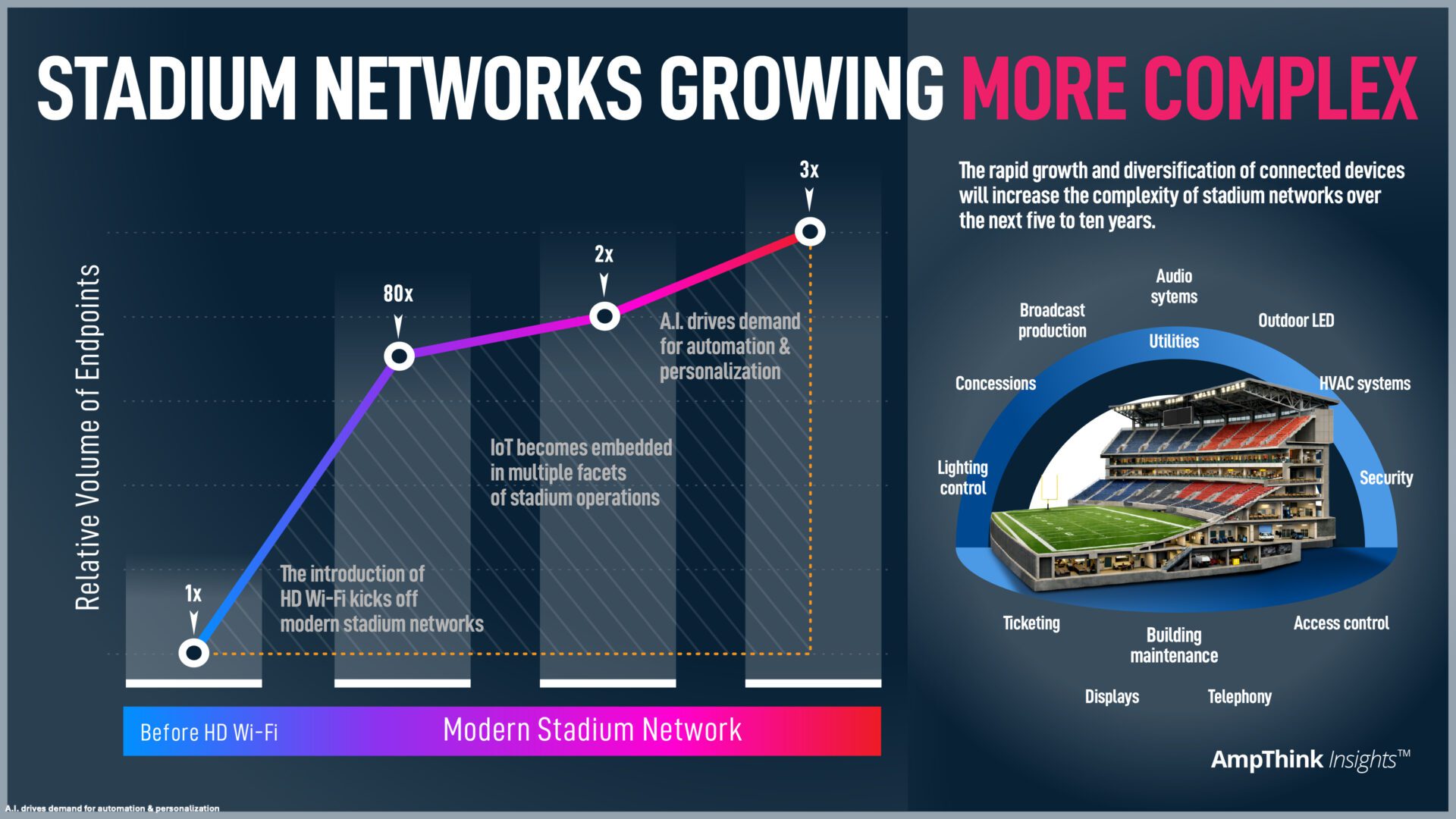


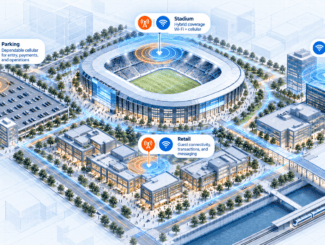
The AmpThink Insight above focuses on stadium networks and shows how rising endpoint counts increase operational complexity as devices multiply and diversify. This progression is organized across three phases.
The first phase, which was the introduction of high-density Wi-Fi, has already occurred. That phase drove change from hundreds of connections to tens of thousands as fan devices became primary network consumers. Modern stadium networks were largely designed around that human connectivity model.
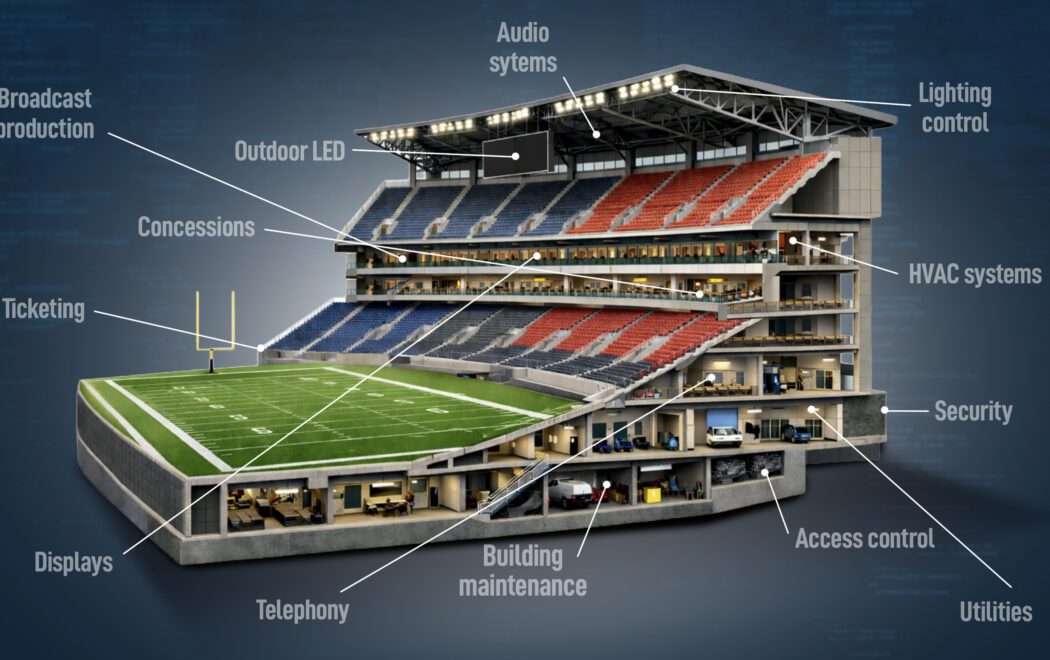
At the same time, most venues evolved by adding parallel networks for different systems. HVAC, lighting controls, broadcast, security, and operational technologies often run on separate dedicated infrastructures. These environments were originally viewed as pillars of reliability and performance. Increasingly, they are becoming silos of data and operational complexity that must each be maintained, secured, and upgraded independently.
The second phase is operational IoT. Building automation, security analytics, frictionless retail, asset tracking, robotics, and predictive maintenance systems are already expanding across commercial real estate because they improve efficiency and increase revenue potential. If those deployments continue to penetrate stadium operations, endpoints could double over the next decade as they align with broader market growth patterns.
The third wave is ambient IoT. Ultra-low power sensors, battery-free tags, continuously connected wearables, and embedded intelligence throughout the environment could push endpoint counts toward three times current levels during peak operations, potentially reaching hundreds of thousands of connected devices in a single venue, with sensor concentration as high as 1 per 20 square feet.
This shift matters because machines introduce different demands than phones. More device types, more protocols, larger security surfaces, and more mission critical dependencies all increase complexity. What was once primarily a fan connectivity platform becomes operational infrastructure.
If the growth trajectory continues, it will challenge conventional network strategies. Software defined and converged network architectures will become essential to allow venue owners to manage scale, segment traffic, and adapt capacity dynamically across systems rather than operating isolated silos.