
As we progress into 2026, the technology and strategies behind stadium audio deployments have never been more important.
For decades, stadium audio was treated as a necessary utility. If the announcements were intelligible, if the music was loud enough, and if the system didn’t fail on game day, it was considered a success. That definition no longer holds.
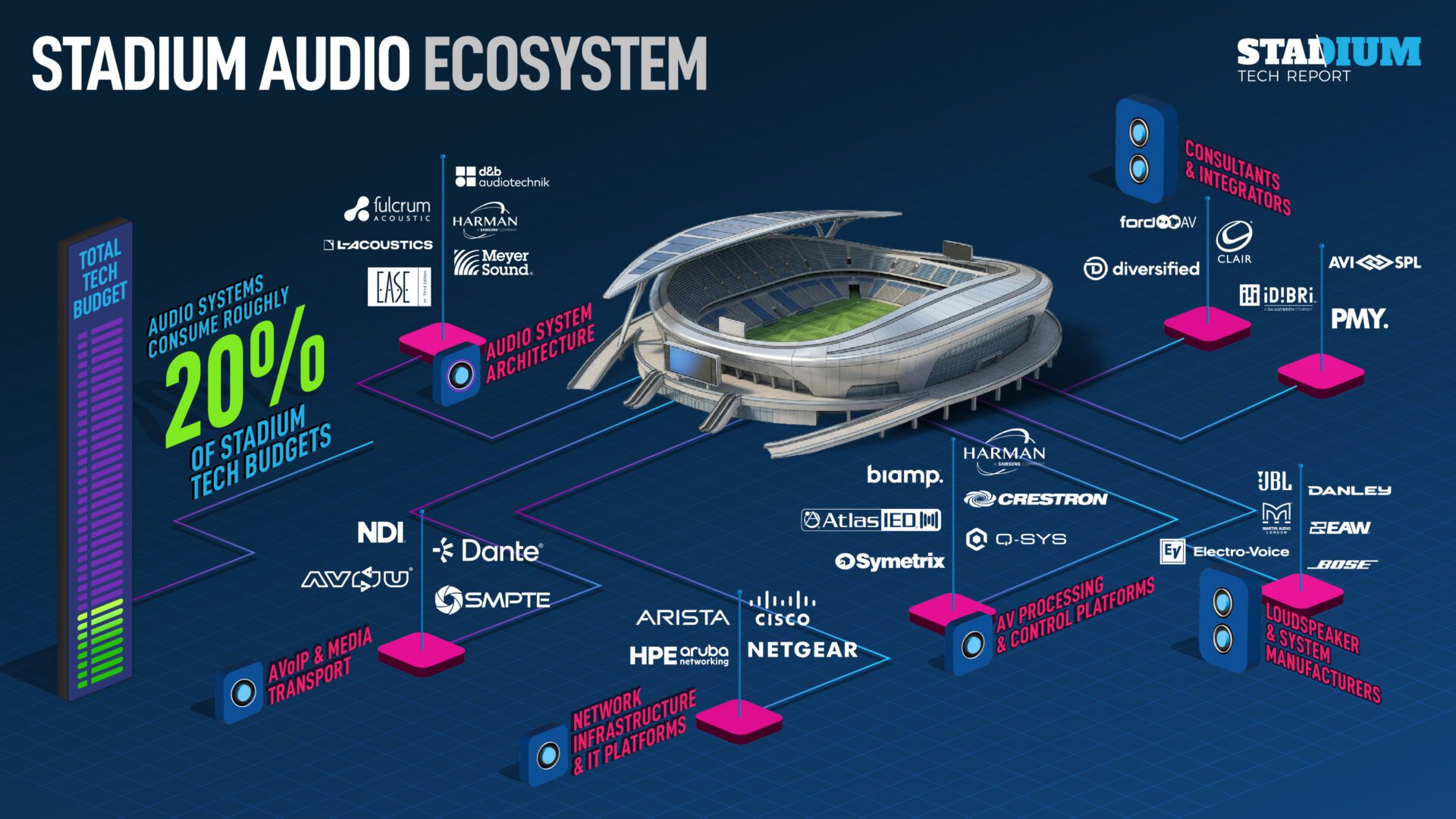
In actuality, few systems command as much capital as audio. It is one of the largest technology investments a stadium owner makes, second only to video displays. Alongside LED boards, audio now shapes the emotional energy of the stadium, the quality of premium experiences, and the value of sponsorship activations. In many venues, audio systems account for roughly 20 percent of total technology spending. Combined with video, that figure can run into the tens of millions of dollars.
Yet despite the size and importance of that investment, the industry lacks a shared method for evaluating stadium audio as a business asset, rather than simply a technical system.
This is the first in a series of articles intended to help venue owners build a framework for investments in audio.


The shift executives need to understand
The most important change in stadium audio is not about speakers, acoustics, or brand preference. It’s about architecture.
From the advent of amplified audio, the challenge of bringing clear, understandable projection of voice and sound to large, widely dispersed crowds has been a challenge.
This is because audio systems were historically designed as self-contained, specialized environments. They relied on large amounts of point-to-point analog cabling, dedicated signal paths, and hardware that was optimized for a single purpose.
These systems had their own set of problems, including distortion and other transmission issues characteristic of analog system cabling. The massive amounts of point-to-point analog wiring used in most stadium audio systems were also costly and time-consuming to deploy. Even worse, they offered no future flexibility once they were installed.
Over the past three decades, that model has undergone significant change. Audio has moved from analog to digital. Signal transport shifted from dedicated cabling to Ethernet. Control moved from racks of specialized hardware to software running on networks. In other words, audio has become IP-based infrastructure.
This architectural shift is foundational. It’s what enables the next evolution in how venues think about sound.
What ‘IP-based audio’ actually means
At its core, IP-based audio allows high-quality, low-latency sound to be transmitted over standard Ethernet networks rather than over purpose-built analog cabling. Technologies such as CobraNet, introduced in 1996, proved the concept, with Dante, launched in 2006, improving on CobraNet’s idea. Dante added features and functionality like auto-discovery and lower latency support to make audio-over-IP better for large venues.
The result was a dramatic simplification of audio distribution. Multiple inputs could be routed to multiple destinations without massive rewiring. Systems became easier to expand, reconfigure, and maintain. Remote management via the network became an important feature addition.
But in many stadiums, this shift stopped halfway.
Audio signals moved onto IP, yet the network itself remained isolated. It was a dedicated audio network running parallel to other venue systems like video, Wi-Fi, building controls, and operations platforms. This preserved familiar design patterns, but it also preserved complexity and cost.
The next step: Converged networks
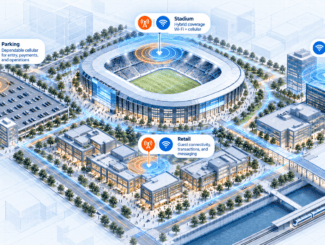
A converged network takes the logic of IP-based audio one step further. Instead of maintaining separate networks for audio, video, and operations, a converged architecture uses a shared, high-capacity IP backbone to support multiple systems simultaneously.
For venue owners, this matters for three reasons:
- Capital efficiency
Shared infrastructure reduces duplicated cabling, switches, and head-end equipment. Audio no longer requires its own parallel network simply to meet legacy assumptions. - Operational simplicity
A single network is easier to monitor, secure, and support. Administrators no longer need to manage multiple isolated environments with different tools and expertise. - Business flexibility
When audio is part of a broader IP ecosystem, it becomes easier to automate, reconfigure, and integrate into revenue-generating workflows from premium experiences to non-game-day events.
This is the point where audio stops behaving like a fixed, stand-alone installation and starts behaving like a platform.
Why this changes the ROI conversation
Most venues intuitively believe audio matters. The challenge has always been quantifying how much it matters and where investment actually pays off.
A useful way to approach audio ROI is to separate the discussion into three questions:
1. What drives cost?
Design decisions, infrastructure choices, legacy standards, and operational models all shape the total cost of ownership. Systems designed as isolated silos tend to carry higher capital and operating costs over time, especially when it comes to network management and system upgrades.
2. What drives value?
Audio contributes to revenue indirectly but meaningfully. It does this through sponsorship activation, premium hospitality, concerts and special events, broadcast quality, and the emotional impact that underpins fan engagement. Audio is part of the “event experience” that differentiates live attendance from watching from home.
3. How is performance measured?
Venues need practical ways to evaluate coverage consistency, operational reliability, staffing requirements, and system adaptability. Regarding quality, the human ear has its limits. Sometimes the difference between good, better, and best is indiscernible to the ear, but impactful to the budget.
Volume, fidelity & control: converged, IP-based architectures influence all three.
What this looks like in practice
At venues that have fully embraced converged networks, audio systems are no longer fragile, staff-intensive environments that require constant expert intervention. They are increasingly automated, remotely manageable, and flexible.
At CPKC Stadium in Kansas City, for example, a stadium-wide converged network supports an IP-centric audio system designed for simplicity and adaptability. Imagine being able to rent a stadium for a private event where you can play your own Spotify playlist over the venue’s speaker system by clicking a single button on a phone or tablet. How is this possible? Because the system is integrated into the venue’s broader operational fabric, not treated as a special case.
At the other end of the spectrum, large venues like SoFi Stadium demonstrate that converged networks can scale while still meeting the demanding requirements of major sports and broadcast productions.
The common thread is not venue size or budget. It is architectural intent.
Why adoption has been uneven
The technology is no longer the limiting factor.
What slows adoption is organizational inertia. Traditional procurement models separate audio, video, IT, and operations into distinct silos. RFPs are often written around legacy assumptions. The audio world is filled with well known consumer brands and high end consultants who command top dollar for premium systems. Yet those products and direction may not always produce the best path forward.
Moving to a converged model requires earlier collaboration, clearer executive ownership, and a willingness to treat audio as digital infrastructure, not a standalone sound package.
Setting the stage for what comes next
This article establishes the foundation: how stadium audio evolved, why IP matters, and why convergence changes the business case.
It’s the first in a series on these topics. Next, Stadium Tech Report will dig deeper into:
- Evolution story: Here’s why IP changed the cost and risk model — permanently.
- Dante story: Here’s why the dominant platform won — and where it may hit limits.
- AVB story: Here’s the credible standards-based alternative — and why it matters.
The goal is not to advocate for a specific product or vendor, but to equip venue leaders with a clearer lens for making “sound” investments.
Because in modern stadiums, sound is no longer just something you hear. It’s something you manage, monetize, and design for the long term.