
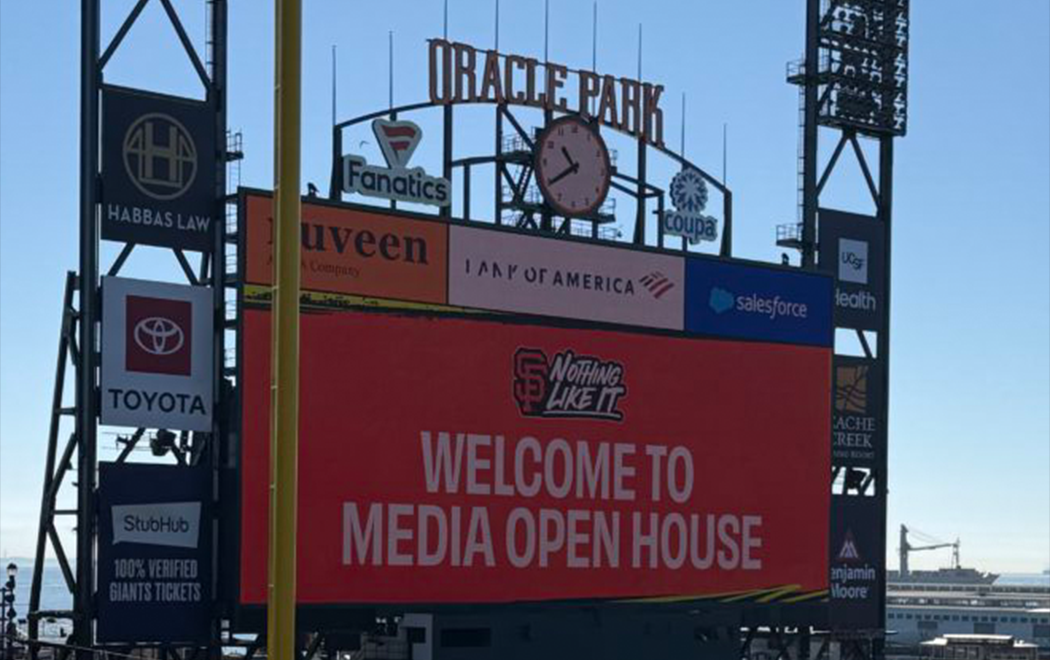
While baseball remains timeless, the venues it is played in are increasingly powered by network platforms built for a generation that thinks digital first. That dynamic was on full display at the San Francisco Giants annual Media Day, where Oracle Park demonstrated how an iconic ballpark must continually evolve to remain a high-performance digital environment. From connectivity upgrades to AI-driven services, the organization is reshaping the fan experience without altering the game itself. At the center of it all is the network, which quietly enables every one of these innovations.
Wi-Fi 6E
A few years ago, Oracle Park became the first outdoor venue with Wi-Fi 6E when it deployed an Extreme Networks based system with partner Comcast. The Chase Center, home of the Golden State Warriors, just a stone’s throw away, had installed an HPE Aruba based system a few months earlier. In both cases, while the equipment was ready to light up the 6 Ghz spectrum, the FCC was not and had a ban on outdoor use.
That day has come and 6 Ghz is up and running at Oracle Park. While waiting for Media Day to start, I tried it, and the performance was outstanding – over 600MB down and over 500MB up on the iPhone 17.
Removing Friction: The rise of the ‘Giants Wallet‘
One of the most significant hurdles in the modern stadium experience is transactional friction. Until recently, a season ticket member buying a hot dog had to perform a multi-step dance: scan a digital ticket for “Splash Cash,” scan a separate membership card for a 20% discount, and then finally pull out a credit card or phone for the remaining balance.
Last year the team installed AiFi and Mashgin systems for a better grab-and-go style experience. This year, the team is removing those multi-steps with the Giants Wallet. Integrated into the MLB Ballpark app, it combines payments, discounts, and loaded value into a single scan. It sounds simple, but the backend requirements to implement it are immense.
“[The] big priority for us is removing friction from the fan experience,” Giants CIO Bill Schlough said. “Now, it’s a single-step process. We just think it’s going to streamline the purchasing process and just get people back to the game quicker.”
Face-First into the future: Go-Ahead Entry
If the digital wallet handles the money, Go-Ahead Entry handles the movement. After successful pilots, the Giants have expanded free-flow facial authentication technology to all four main ballpark entrances, including the newly renovated Willie Mays Gate.
This technology allows fans to enter the park hands-free at a walking pace. You don’t pull out a phone; you just walk in and the system greets you personally. The Giants expect 10% to 20% of the crowd to use this system this year, aiming to eventually chase down the Houston Astros, who currently lead the league in adoption.
For the privacy-conscious, Schlough is quick to clarify that this isn’t “surveillance”—it’s math. “We’re not storing the face,” he said. “We just know that you scanned your face and it’s a bunch of ones and zeros. When you come in again, the same ones and zeros appear – it’s purely to expedite entry.”
The AI Frontier: ElevenLabs and internationalization
Perhaps the most “2026” announcement was the partnership with ElevenLabs, a leader in AI-powered voice generation. While the team is keeping specific use cases close to the vest, the potential is transformative, especially for a team with an increasingly global footprint.
With the arrival of stars like Jung Hoo Lee, nearly 15 percent of the Giants’ 2025 YouTube content views have come from South Korea. Generative AI allows the team to create localized, personalized content in multiple languages at a speed that was previously impossible. Whether it’s customized broadcast highlights or personalized ticketing offers, AI is the engine that allows the Giants to scale their personality across the globe.
The unsung hero: Why the Wi-Fi network is everything
It is easy to get distracted by the 16-ounce Mini Cooler Cups, Hello Kitty Night, the new 4mm Mitsubishi LED boards, or the “Airwallex” jersey patches. However, the most critical piece of tech in the building is the one you can’t see.
As mentioned previously, Oracle Park was one of the first venues to deploy Wi-Fi 6E, which opens a new spectrum for digital access, providing lower latency and higher speeds than ever before.
Stadium Tech Report asked Schlough how his view on connectivity has evolved. His answer was telling: Wi-Fi is no longer an “amenity;” it is a business enabler. “We don’t have to worry about connectivity at the park. It enables us to say, yes, we’re going to go with Go-Ahead Entry.”
Consider the business models mentioned above. The Giants Wallet fails if the app can’t refresh a QR code at a concession stand in a crowded concourse. Go-Ahead Entry fails if the “ones and zeros” of a fan’s face can’t be verified against the cloud in milliseconds. Even the Oracle Park Replay Pilot Program, which uses reusable cups tracked via Vytal Global, requires a connected environment to manage inventory and sustainability metrics in real-time.
Without a reliable Wi-Fi network, built for high density, a “Smart Stadium” is just a building with expensive gadgets that frustrate fans. By implementing 6E, Schlough has freed his team to experiment with high-bandwidth ideas like ElevenLabs’ AI voices or augmented reality displays without fearing a network crash.
The ‘Mission Rock’ ecosystem
The connectivity doesn’t stop at the stadium walls. The development of Mission Rock, the new neighborhood across McCovey Cove featuring the Visa headquarters, Blue Bottle Coffee, and the “Hearts in San Francisco” art installation, represents a shift from a “stadium” to a “campus.”
In this ecosystem, the Giants are more than just a sports venue; they’re also a real estate and technology platform. Whether a fan is sitting in the new Shield Lounge or grabbing a “Peruchín Sandwich” at a kiosk in China Basin Park, they are part of a continuous digital thread.
Private cellular complements Wi-Fi
In addition to Wi-Fi, private cellular is also being used for bespoke use cases. On March 18, the Giants hosted MLB’s opening night when the team took on the New York Yankees. This was the first MLB game ever broadcast on Netflix but was also the coming out party of the new Automated Ball-Strike (ABS) Challenge System running on T-Mobile’s private 5G. The system uses 12 Hawk-Eye cameras to track pitches and enables teams to challenge balls and strikes for more accurate calls.
Conclusion: The 21st century pastime
Oracle Park is 27 years old this year. In “stadium years,” that’s middle-aged. Yet, through aggressive investment in Wi-Fi and strategic partnerships with AI and other technologies leaders, I’ve often found the stadium feels much younger.
As Schlough put it, “We want the ballpark to feel new for fans who come in. And I feel like one of the best ways to do that is through digital displays, through the sound system and ensuring that wherever you go, you’re never separated from the action.” The 2026 season is proof that in San Francisco, the “Hallowed Ground” is also a “High-Tech Ground,” enabled by a Wi-Fi network that is built for the rigors of high density.