
Ohio Stadium, home to one of the biggest, highest-performing stadium Wi-Fi networks anywhere, will now be leading the large-venue market into an AI-managed future with a Juniper Mist-powered Wi-Fi 7 upgrade that is already underway.
According to technology executives at The Ohio State University, a campus-wide strategic initiative in 2025 to move all Wi-Fi platforms to an AI-based network management system ultimately expanded to include an upgrade of the stadium’s seven-year-old Wi-Fi 6 network, which is scheduled to be completed ahead of the 2026 football season.
Ryan Holland, director of Enterprise Networking for the university’s Office of Technology and Digital Innovation (OTDI), said the move to an artificial-intelligence network management model for the entire campus as well as the stadium networks was an easy choice, mainly due to the technology’s ability to streamline, automate, and improve administration and management tasks.
After testing the Juniper Mist technology in a lab environment, Holland said the university moved to a proof-of-concept test in a single building. Feedback from that test on metrics including connection success rates, endpoint throughput, and other performance measures looked very positive, prompting the school to expand its PoC testing to a library, a multi-classroom building and a large lecture hall.
“All sites saw terrific results in reduced Wi-Fi complaints in high-density areas,” Holland said of the second round of testing. “We knew we needed to begin investing in Wi-Fi 7, and Juniper Mist proved itself first-hand, so the decision was made.”
Once Ohio State later decided to move forward with the stadium Wi-Fi upgrade, it was a choice between Aruba Networks (the incumbent provider) and Juniper Mist, Holland said.
“After consulting with HPE Networking and with our partner, PIER Group, we collectively decided to leverage HPE Juniper Mist for the large public venue,” Holland said.
School officials said Hewlett-Packard Enterprise’s (HPE) acquisition of Juniper later in 2025 was an unexpected fortunate event as well, since the school and stadium could keep and extend important technology relationships established during the original network installation. According to Ohio State, the stadium network will expand from approximately 1,800 access points to over 2,000, using primarily devices from the Juniper Mist AP66 series.
Rob Lowden, vice president and CIO of The Ohio State University, who recently posted photos of the already-underway stadium renovation on LinkedIn, said the stadium network will be the largest single deployment of HPE Juniper Mist in a large public venue in the U.S.
“This project represents a significant investment in the future of the fan and event experience at Ohio State,” Lowden said in his post. “We’re replacing legacy infrastructure, expanding coverage and capacity, and building a wireless environment designed to support the scale and density of one of the largest venues in the country.”
Why AI-based Wi-Fi management makes business sense for venues
Even as AI technology conjures up strong emotions both positive and negative across the broader world, the relatively narrow and specific realm of Wi-Fi network management can offer easily measured AI-based performance gains that both improve network operations and make administrators’ time more efficient.
Unlike doomsday scenarios about AI technology taking over the world, early adopters of AI network management in the stadium space are enthusiastic about the technology’s potential to automate repetitive tasks and provide continuous monitoring and reporting, allowing network administrators to make faster, better decisions.
Though Ohio State has not used the technology long enough to provide a long list of discrete improvements, Holland said the proof-of-concept tests showed that Juniper’s Mist technology provided exactly the benefits the university was looking for.
“It’s more about bubbling up all of the information in a way that allows an engineering team to make decisions and take action,” Holland said of the AI performance. “There are some low-risk, well-identified situations on a network that always have the same root cause. These are the types of occurrences that can be resolved automatically.”
One specific example Holland gave of AI providing automated help was a “stuck port” situation, where bi-directional traffic on a switch port may suddenly start flowing in only one direction.
“The fix for that (problem) is bouncing a switch port,” Holland said. “There’s no reason an engineer needs to be involved in that, and Mist can actually bounce the switch port on its own, see that the traffic is now bi-directional, and it can say, hey, I saw this and I did this.”
Though Wi-Fi networks already generate plenty of internal data, that information is often buried across multiple dashboards and monitoring tools, depending on the management software in use. Another benefit of Mist AI is its conversational interface (called the Marvis AI Assistant), a natural language processing (NLP)-based system that allows administrators to simply ask questions instead of sorting through data from multiple sources.
“You can interact with it in a natural language for troubleshooting,” Holland said. “For example, I could ask, ‘tell me what performance issues we are having on Level 8 (the level of the stadium that includes the press box),’ and it could tell me everything that it sees there. It’s more conversational, instead of having to go screen by screen.”
Why now for the stadium Wi-Fi upgrade
After the 2019 install of the Wi-Fi 6 network, Ohio Stadium quickly rose to the top of the former Stadium Tech Report “Top Wi-Fi events” lists, including a Michigan game in 2022 with 34.8 terabytes of data used, an event that was ranked No. 1 the last time STR reported such figures.
Holland said Ohio State had considered getting one more season out of the stadium network, since the system was not yet showing critical capacity constraints. However, growing concerns about coverage gaps, especially at entry gates, ingress ramps, and some lower-bowl seating areas with the wide seat spans between aisles, prompted the school to start the upgrade this year.
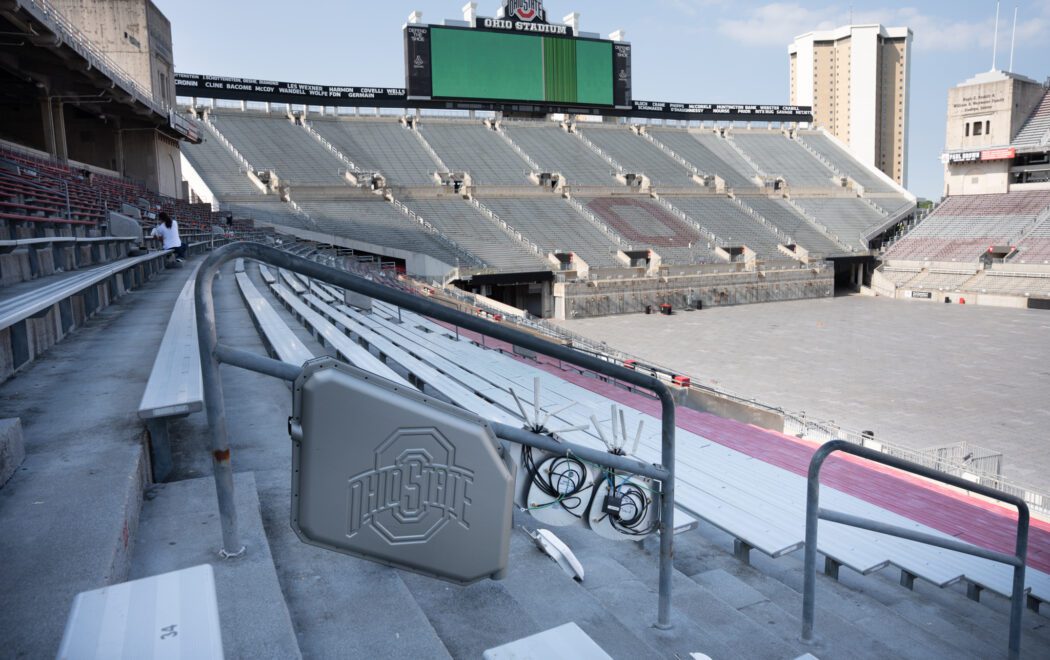
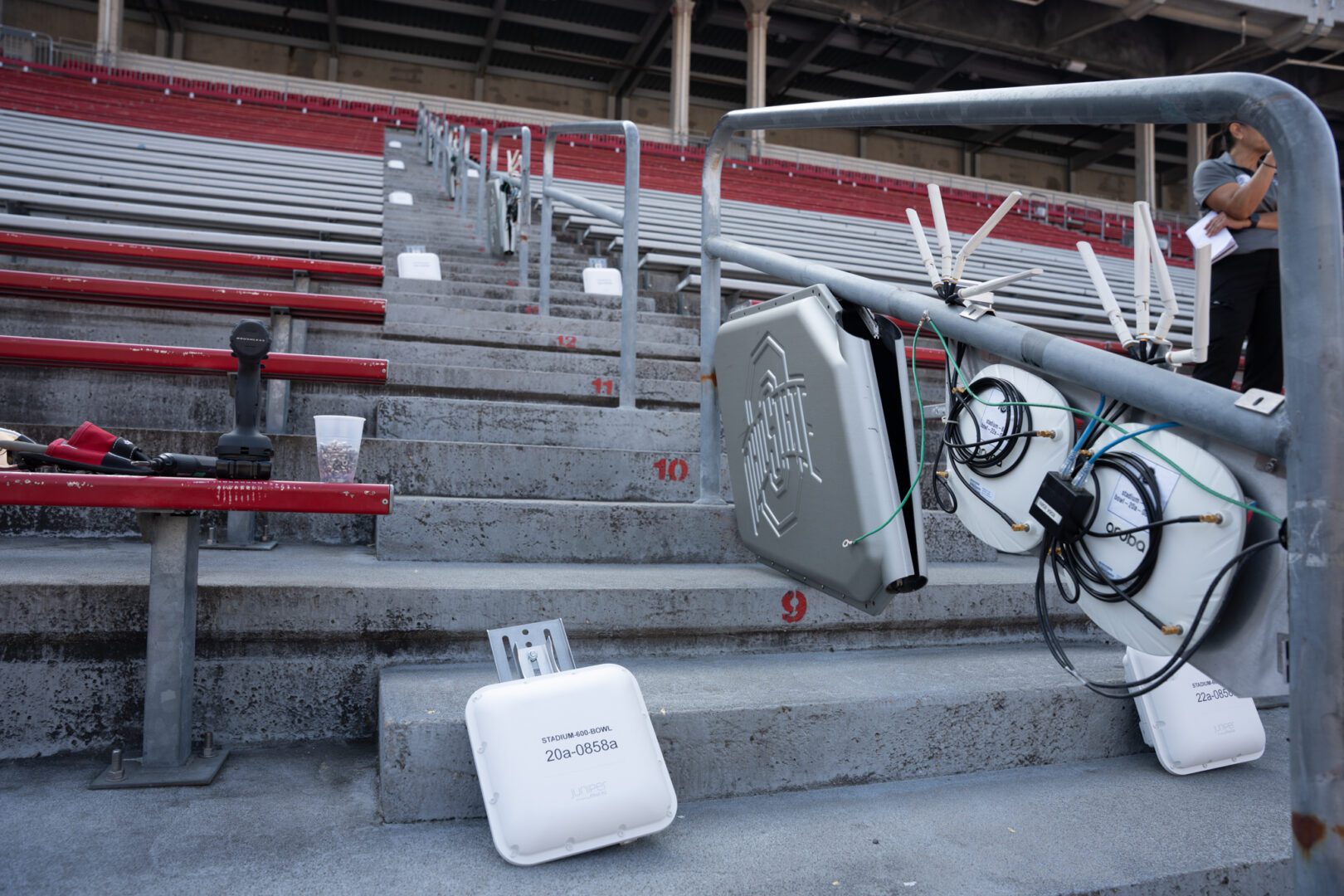
According to Holland, the number of total APs in the stadium network will increase from 1,800 to over 2,000. Half of the new devices will be installed in the seating bowl, with some new underseat deployments joining the devices in the iconic handrail AP enclosures designed and installed by Master Technology Integrator AmpThink during the initial 2019 deployment.
Holland said hands-on engineering work is being done by partner PIER Group and its affiliate LPV Professionals to fit the larger Juniper gear into the clamshell enclosures, including some metal-shaving on the handrail side to make them fit.
“Our partners have done that work elegantly,” Holland said.
By replacing the former Aruba gear with the AP66 and AP66D Juniper devices, Holland said overall coverage in the handrail enclosures should significantly improve, since the Juniper devices can radiate directionally.
Though Juniper Wi-Fi gear has not been part of the general stadium network market, the company did gain visibility with a successful deployment at the recent Winter Olympics in Italy, where Mist software and hardware were installed across all venues used by the games. Holland said the addition of Juniper gear at Ohio State will be easier because the school already uses Juniper core and edge networking equipment.
“We expect the zero-touch provisioning functionality of Juniper Mist will decrease the time it takes to perform annual access point refreshes and edge switch refreshes, of which we perform roughly 3,500 and 300 respectively each year,” Holland said. “The less time spent on that activity, the more time engineers can spend focused on innovation and overall network performance.”
Aiming for a September launch
If the deployment goes as scheduled, the first live test of the full stadium network should come on Sept. 5, when Ohio State hosts Ball State in its 2026 season opener. The real stress tests, however, will come later with big games like Illinois on Sept. 26, and Oregon on Nov. 7. Ohio State will have a full season before hosting traditional rival Michigan in the “Big Game” on Nov. 28.
Along the way, Stadium Tech Report will track the network’s performance, a system that will likely be closely watched by the broader sports networking market. With one of the newest technologies making its debut in one of the largest stadiums anywhere, HPE’s AI-based network management systems will face one of the toughest tests yet in its first major U.S. football stadium deployment.