
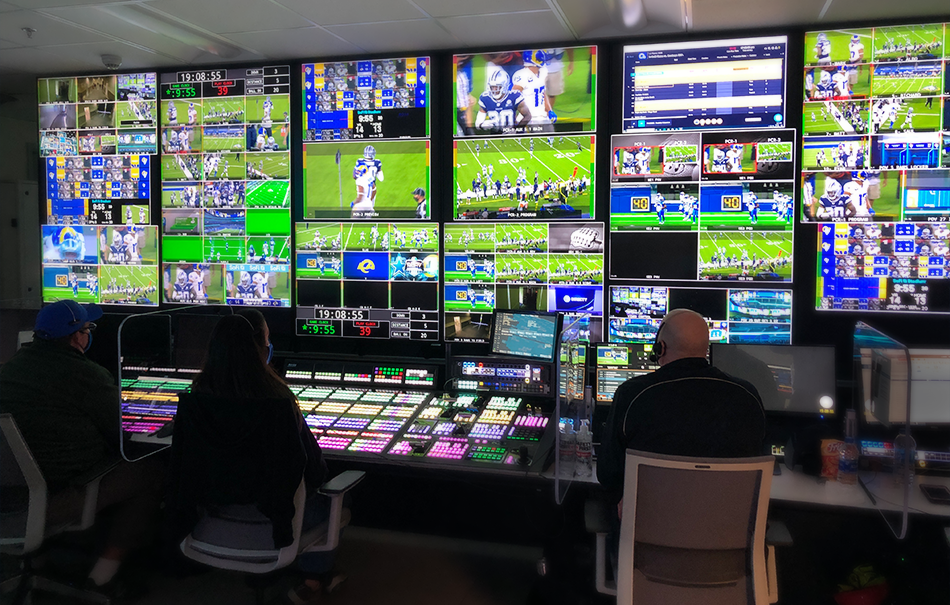
Over its almost two-decade life span, the audio-over-IP protocol known as Dante has established itself as the market leader in stadium and large public venue audio installations. With its relative ease of deployment and its wide industry support, Dante has become the default audio-over-IP delivery mechanism for most of the larger public venues like sports stadiums and arenas.
Though it operates mainly over standard Ethernet and Internet Protocol (IP) based networks, the technology known as Dante (for “Digital Audio Network Through Ethernet”) is a proprietary product. It requires manufacturers of audio devices like amplifiers, speakers, and control equipment to pay royalties to incorporate Dante interoperability to their products. End users like stadiums pay for Dante directly software licensing fees for enhanced management and functionality, and indirectly by purchasing Dante-enabled products.
While Dante is the market leader for stadium audio-over-IP by a large margin, now in 2026 there is a growing need for a better, more standards-based approach to venue audio networking. This may create more opportunities for Dante competitors who seek to improve on Dante’s flaws while also targeting the product’s expensive licensing fees. Audinate, the company that developed and owns Dante, reported a 32 percent decline in revenue for fiscal year 2025 while also recording a net loss of $4.27 million compared to a profit in fiscal year 2024. This is a notable sign of a drop in Dante’s dominance.
In this article we’ll look at the innovations that helped Dante win the lion’s share of the stadium audio-over-IP market. We’ll also discuss why those initial choices may not prevail in a future that could be trending more toward a standards-based approach for networked audio.
How Dante was developed and the technologies that led to it
According to company history, the initial idea for Dante came from co-founder Aidan Williams, an engineer at Motorola Research Labs, who was reportedly frustrated with the complex cabling setups required for his home music studio. To solve his problem he started looking into how to treat audio as a data networking challenge, using standard Ethernet to replace proprietary cables.
This idea had already been proven in the audio marketplace several years earlier, when a company called Peak Audio from Boulder, Colo., introduced CobraNet, the first successful enterprise-level product to carry audio signals over Ethernet networks. With CobraNet, venues could realize significant cost and operational savings through the ability to replace bulky legacy analog cabling systems with cheaper, thinner Ethernet infrastructure. Its ability to support flexible design and reconfiguration of networks led to many large-venue audio CobraNet deployments following its 1996 release.
But CobraNet’s technical limitations, which were not improved upon by its owners, led to more innovation from others on the audio networking front. Since it transferred data using data link packets, which are a Layer 2 protocol, CobraNet was mostly limited to single-premise deployments since its packets could not travel through routers. CobraNet also was written to make use of 100Mbps “Fast Ethernet,” a limitation as Ethernet speeds increased to gigabit levels with continued innovation. Other protocols emerged in the market as more firms tried to improve on the basic ideas of IP-based audio.
What made Dante different
In Australia, Williams and a small team of his fellow ex-Motorola employees got backing from the National Information and Communications Technology of Australia (NICTA) to develop Dante. It took them three years to build the foundation of what would become the Dante protocol, eventually creating a new company called Audinate, in 2006.
What made Dante different from CobraNet and other Audio-over-IP competitors was its ease of use, its embrace of newer network advancements, and its attention to lower latency. Unlike CobraNet, Dante operated at the Layer 3 network level, so it could run on commodity Ethernet switches with no special hardware requirements. Since Dante packets could be routed, venues could now support communication between different networks by routing packets across a larger or wide-area network.
Dante also supported higher channel counts per link, as well as configurable, lower-level latency. Both of these attributes worked well in stadium audio situations, which were now calling for multiple audio inputs and outputs, and real-time, live performance synchronization of audio broadcasts.
But what really made Dante stand apart was its auto-discovery feature, which was unique. According to the company, a Dante-enabled device connected to a network will automatically set up its own network configuration, including its own IP address. A Dante-enabled device will also advertise information about itself to other Dante devices and the Dante Controller (the protocol’s software management platform), including:
- Device name
- Channel names
- Number of channels
- Sample rates and bit depths
According to Audinate, this information can be seen when viewing a device on Dante Controller, and allows Dante devices to determine compatibility with other devices, such as compatible sample rates to allow media to be routed.
Breaking through to the stadium market
In 2008, Audinate and Dante found an early advocate in audio pioneer Bruce Jackson, vice president of Dolby Labs’ Live Sound Division. With Jackson’s support, the Dolby Lake Processor (a high-end digital signal processing system for live sound) became the first Dante-equipped professional audio device, making its debut at a Barbra Streisand concert in Washington, D.C.
Following that public debut, a period of accelerated market growth took place, with Dante being deployed in several high-profile, mission-critical events, including multiple venues of the 2010 Winter Olympics in Vancouver and the Queen’s Jubilee Concert in London. Several major stadiums then deployed Dante for their audio systems, leading to wider adoption.
What most venues found is that using Dante for their audio simplified their complex setups, significantly reducing setup time and errors compared to analog systems.
By 2012, most of the leading professional audio brands had embraced Dante technology in their flagship products, including Yamaha, Bosch, Harman, and Shure, among others. The wide support of manufacturers putting Dante technology into their products made it easier for venues to adopt the protocol, and increased the Dante market share.
The continued improvement of Dante technology by Audinate over the years of its existence still makes it the top choice for the largest venues with the most demanding audio networks. In the past five years, venues including SoFi Stadium in Inglewood, Calif., and AT&T Stadium in Arlington, Texas have both installed Dante-based networks to control their massive audio infrastructures.
If CobraNet had showed that Audio over IP could be done, Dante showed how it could be done well. However, Audinate’s control of its proprietary technology may be what keeps Dante from extending its market dominance deeper into the future. A competing technology known as AVB (for Audio Video Bridging), a set of open IEEE standards that allow for the transmission of high-quality, low-latency audio and video over a standard Ethernet network, is already attracting big-venue customers with a feature and price combination aimed directly at Dante.
Dante’s simplicity may be a hindrance
As stadium audio networks expand in their size, complexity and needed features, some of the factors that made Dante a simple choice may not match well with the stadium audio needs of the future.
Though the auto-discovery feature of Dante is a time saver in most cases, it does not extend across routers. This means that networks with routed links require extra administration to ensure network setup is performed correctly. Dante also still supports a feature that auto-selects the master timing device in a network with a default to the lowest-order MAC address. Again, if a network operator does not want this default, it requires extra administration to overcome the default setting.
And while Dante does support configurable levels for quality of service, these also require administrative care and may be based on best-effort methods. One of the new competing protocols for stadium-size networks, the standards-based AVB, allows network operators to reserve bandwidth for AV traffic, ensuring high quality of service levels. It also has its own method of auto-discovery for networked devices.
As stadium networks grow in size and components, royalty-free standards-based systems like AVB will have a potential cost savings over Dante, which has a per-port charge for its software licensing fees. Though AVB-compliant switches can cost more than the off-the-shelf switches that can be used in a Dante network, the general consensus is that the per-port cost savings, especially in larger networks, will outweigh the higher switch costs.
Will Dante be able to keep up with standards?
Even as its proprietary Dante protocol remains its main business model, Audinate has done a better job supporting standards than some other proprietary technology market leaders. The main protocol for audio-over-IP interoperability, the Audio Engineering Society’s (AES) AES67, is supported by Dante for enabling interoperability between Dante networks and networks using other protocols. However, not all Dante-enabled products support AES67, and the feature set available to non-Dante devices over a Dante-via-AES67 link may be limited.
While AVB networks also require integration work to function with AES67 communications, the main features of AVB (including its bandwidth reservation schemes) will not work over AES67.
AVB is now a subset of another IEEE standards effort, known as Time-Sensitive Networking (TSN), which can extend and enhance AVB networks, adding features like time-sensitive traffic scheduling and improved traffic management. For many users, a standards-based approach is seen as a more sustainable path for the future of any technology, since it is not reliant to or held hostage by a single business entity.
If Dante has been the default market leader in audio-over-IP for many years, the financial underperformance of Audinate in fiscal year 2025 (the company recorded $41.58 million in revenue, a 32 percent drop from fiscal year 2024) is a blip in its dominance. However, Audinate is not in trouble financially, and in June 2025 it acquired a company called Iris Studio, whose technology could bring artificial intelligence features to camera controls, potentially enhancing Dante’s use for video as well as audio networks. The interesting competition to watch may be to see how AVB stacks up against Dante as more new stadiums come online in the near future. The choice for venue audio deployments may come down to Dante’s attributes of simplicity, flexibility, and integration with existing standard networks versus AVB’s ability to support a tightly controlled, high-performance, and potentially lower overall cost (per-port) system. The good news for venue owners and operators is that with more competition there usually comes more innovation and better pricing. In the increasingly costly and complex world of stadium audio, that is potentially pleasant music to the purchasers’ ears.